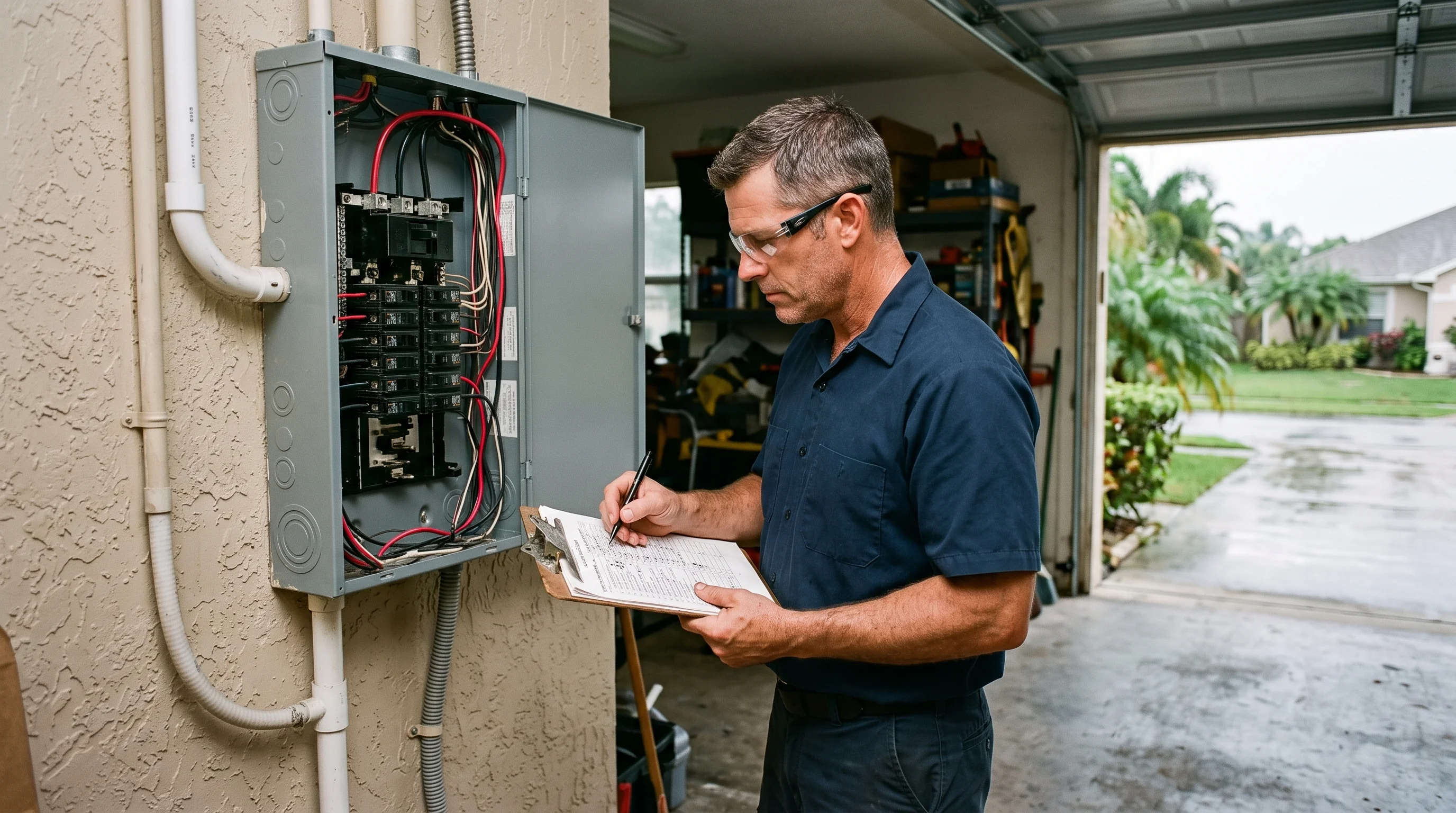
If a 4-point inspection report just landed in your inbox, you probably have two feelings at once: relief that it’s done, and confusion about what half the line items actually mean. “Panel type: FPE Stab-Lok — flagged.” “Supply piping: polybutylene noted.” “HVAC age: 14 years.” None of that tells you whether you have a real problem or a minor note your insurer will wave through.
Here is the short version: a 4-point inspection checks four systems — roof, electrical, plumbing, and HVAC — and Florida insurers require it on homes more than 20 years old before they’ll write or renew a policy. Some of what gets flagged is genuinely urgent (an outdated electrical panel with a documented fire-risk history, for example). Some of it is a note that won’t affect your coverage at all. The rest of this guide walks through each system, what actually causes an insurer to push back, and roughly what it costs to fix — using real, published pricing from a Broward County contractor who handles three of the four trades involved.
World Air HVAC is licensed for HVAC, electrical, and plumbing (license CMC1250582) and does not do roofing. We’ll be straight about that scope throughout — including telling you when the fix on your report belongs to a roofer, not us.
What a Florida 4-Point Inspection Actually Checks — and Why Insurers Require It
A 4-point inspection is narrower than a standard home inspection. It does not evaluate cosmetic condition, appliances, cabinetry, or flooring. It exists for one reason: to give an insurer a snapshot of the four systems most likely to produce an expensive claim — a roof leak, an electrical fire, a burst pipe, or a failed HVAC system — on a home old enough that those systems are statistically more likely to be near the end of their service life.
Citizens Property Insurance Corporation, Florida’s state-backed insurer of last resort, publishes the requirement plainly: a 4-point inspection is required for property owner, dwelling, and mobile home applications on properties more than 20 years old. Most private carriers operating in Broward County apply the same 20-year threshold or something close to it. The inspection has to be performed by a Florida-licensed inspector and is generally only good for about 12 months from completion — an old report from a prior sale usually will not satisfy a new policy application.
Citizens Property Insurance Corporation states directly: “Citizens requires a four-point inspection for all property owner, dwelling and mobile home applications for properties more than 20 years old.” The inspection covers the electrical system, plumbing, HVAC, and roof. Source: citizensfla.com/inspections.
The inspector isn’t grading your home’s style or age on its own — an older home with a newer roof, an updated 200-amp panel, PEX plumbing, and a well-maintained AC system can sail through a 4-point with no findings at all. What actually gets flagged is outdated or hazardous materials and equipment nearing failure, regardless of when the house was built.
The Four Systems, One at a Time
Roof (Not a World Air Service)
Inspectors note the roof’s covering material, its age, visible damage, and remaining useful life. A shingle roof nearing or past its rated lifespan, exposed underlayment, or visible active leaks are the findings that typically trigger insurer pushback. Roofing is outside World Air’s scope of license, so if this is the item on your report, you’ll need a licensed roofer — we’re happy to point you toward that conversation, but we won’t pretend it’s something we do.
Electrical
This is where we see the most insurance-blocking findings on Broward County homes, and it’s the one worth taking most seriously. The inspector documents your panel’s brand, amperage, and condition, along with wiring type and any visible hazards. Homes built in the 1970s through 1990s commonly still carry a Federal Pacific (FPE Stab-Lok), Zinsco, or Challenger panel — three brands with documented histories of breakers that fail to trip during an overload. That’s not a cosmetic note; it’s a real fire-risk finding, and a large share of Florida carriers will not write or renew a policy until the panel is replaced.
Other electrical findings that show up regularly: aluminum branch wiring (common in homes built 1965–1973), a panel rated at 100 amps or less trying to run a modern home’s AC, appliances, and electronics, missing GFCI protection in wet locations, and no whole-house surge protection — a real risk in Broward County, which sits in one of the most lightning-dense regions in the country.
Plumbing
The plumbing section looks at supply pipe material, age, and any signs of active leaks. The two materials that consistently get flagged in older Broward County homes are polybutylene (gray plastic pipe common in 1970s–1990s construction, prone to sudden failure) and galvanized steel (used before 1970, corrodes from the inside and restricts flow). Neither is an automatic insurance denial the way a Federal Pacific panel often is, but both are treated as elevated risk, and an inspector who spots active dripping, corrosion at fittings, or a recent leak history will note it.
HVAC
The HVAC section checks whether the system is present, functioning, and appropriately maintained for its age — not whether it’s brand new. An AC system that runs, cools properly, and shows no signs of neglect generally passes even at 10–12 years old. What draws attention is a non-functional unit, an improperly installed system, or clear signs of long-term neglect. Florida’s climate is hard on equipment — systems here run 10 months a year, and a lack of maintenance records can factor into how an inspector characterizes the system’s condition.
Federal Pacific, Zinsco, and Challenger panels have documented histories of breakers failing to trip during overloads. Multiple Florida insurance agencies report that the majority of carriers they work with will not write a policy on a home with an FPE panel, and Zinsco and Challenger panels face nearly as much restriction. If this is on your report, treat it as a priority — not a line item to get to eventually. Source: Augustyniak Insurance Group.
Common Findings, Typical Fixes, and What They Cost
The table below covers the findings we see most often on Broward County 4-point reports, organized by trade. These are World Air’s own published price ranges for the electrical, plumbing, and HVAC work — not national averages.
| Common Finding | Trade | Typical Fix | Approximate Cost |
|---|---|---|---|
| Federal Pacific, Zinsco, or Challenger panel Most Common Fail | Electrical | 200-amp panel replacement, permit & inspection | $1,800–$3,500 |
| No whole-house surge protection | Electrical | Install whole-house surge protection at the panel | $300–$600 |
| Polybutylene or galvanized supply pipe | Plumbing | Whole-home repipe with PEX or copper (2–3 days) | Custom quote after inspection |
| Recurring clog / possible root intrusion noted | Plumbing | Camera inspection + drain cleaning or hydro-jetting | $150–$350 |
| AC system 12+ years old, no maintenance history | HVAC | Tune-up & inspection first; replace only if warranted | $89–$149 tune-up ($5,000–$12,000 if replacement is needed) |
| Roof at or near end of rated life | Roofing | Licensed roofer repair or replacement | Outside our scope — ask us for a referral |
Notice that repiping doesn’t get a flat price here. A whole-house repipe depends on square footage, number of fixtures, and whether the pipe is accessible through an attic or has to be routed through walls — it genuinely needs a walkthrough. Anyone who quotes you a repipe over the phone without seeing the house is guessing. If your report flagged polybutylene pipe specifically, our full guide to polybutylene and Florida insurance covers why insurers care and what the replacement process actually looks like.
What Actually Fails vs. What’s Just a Note
Not everything on a 4-point report is a dealbreaker, and treating every line item as equally urgent leads to either panic-spending on things that don’t matter or, worse, ignoring the one item that does. A rough way to sort your report:
- Almost always urgent: Federal Pacific, Zinsco, or Challenger electrical panel; active roof leak; active plumbing leak; non-functional HVAC system.
- Usually worth addressing but rarely an outright denial: aluminum wiring, galvanized or polybutylene pipe with no active leak, a roof nearing but not past its rated life, an HVAC system 12–15 years old that’s still cooling properly.
- Often just documentation, not a repair item: panel amperage on the lower end but not overloaded, minor missing GFCI outlets in a single location, cosmetic wear noted without a functional issue.
The report itself usually doesn’t make this distinction for you — it’s written for an underwriter, not a homeowner. This is exactly why it’s worth having a licensed contractor walk through it with you before you assume the worst or, just as costly, assume nothing needs attention.
Who Do You Call for Each Failed Item?
Most homeowners end up calling three or four separate contractors to close out a single 4-point report — an electrician for the panel, a plumber for the pipe finding, an HVAC company for the system note, and a roofer if the roof was flagged. That’s a lot of scheduling and a lot of separate invoices for one report.
If your report flagged an outdated panel, our electrical services page covers panel upgrades, surge protection, and rewiring in detail, and if a Federal Pacific or Zinsco panel is specifically what you’re dealing with, our companion guide on Federal Pacific and Zinsco panels and Florida insurance goes deeper into why insurers treat these panels differently and what the replacement process looks like. If the finding is polybutylene pipe, an active leak, or a recurring clog, our plumbing services page covers repiping, leak detection, and drain service. If the HVAC system itself was the note, our AC installation & repair page covers both tune-ups and full replacement.
The advantage of handling electrical, plumbing, and HVAC under one company isn’t just convenience — it’s that our electricians, plumbers, and HVAC techs already understand how these systems interact in the same house, which matters when a panel upgrade also needs to support a newer AC system, or a repipe runs through the same wall cavity as new wiring.
How to Get Your Home Re-Inspected and Insured
Once repairs are complete, the process to close the loop with your insurer is straightforward:
- Complete the repair with a licensed contractor and pull the required permit — unpermitted work typically will not satisfy an underwriter, even if the repair itself is done correctly.
- Get the permit closed out with a passed final inspection from the local building department.
- Provide the completed work and permit documentation to your agent or insurer. Some carriers will accept photos and the closed permit; others want a fresh 4-point inspection reflecting the change, particularly if the original panel or pipe finding was the reason coverage was conditional.
- Ask your agent directly what they need before scheduling anything — requirements vary enough by carrier that it’s worth a five-minute call rather than guessing.
If you’re buying a home and the 4-point came back with findings, this same process applies before closing or shortly after, depending on how your contract and lender handle it. If you’re renewing an existing policy, most carriers give you a defined window to complete repairs before non-renewal takes effect — don’t let that window slip while you’re still shopping quotes.
If your report flagged both an electrical panel and a lower-priority item like a repipe candidate with no active leak, get the panel replacement scheduled first. It’s the finding most likely to actually block or cancel coverage, and permit-to-inspection turnaround on a panel swap is typically faster than a whole-home repipe.
Frequently Asked Questions
What is a Florida 4-point inspection and why do I need one?
A 4-point inspection is a focused review of your home’s roof, electrical system, plumbing, and HVAC (heating and cooling) system, performed by a Florida-licensed inspector. Insurers use it to evaluate risk on older homes before writing or renewing a policy. Citizens Property Insurance Corporation requires a 4-point inspection for property owner, dwelling, and mobile home applications on properties more than 20 years old, and many private carriers apply a similar threshold. It is not a full home inspection — it does not evaluate cosmetic issues, appliances, or interior finishes. It only looks at the four systems most likely to cause a major insurance claim.
What age home requires a 4-point inspection in Florida?
Citizens Property Insurance Corporation requires a 4-point inspection on any property owner, dwelling, or mobile home application for a home more than 20 years old. Most private insurers in Florida use the same 20-year threshold or something close to it, though the exact policy varies by carrier. The inspection generally has to have been completed within roughly the last 12 months at the time you submit it, so an old report from a previous sale or renewal usually will not satisfy a new insurer.
What’s the most common reason a 4-point inspection fails in Broward County?
The single most common insurance-blocking finding is the electrical panel. Homes built in the 1970s through 1990s in Broward County frequently still have a Federal Pacific (FPE Stab-Lok), Zinsco, or Challenger panel — brands with a documented history of breakers that fail to trip during an overload, which is a real fire risk. A large share of Florida carriers will not write or renew a policy on a home with one of these panels until it’s replaced. Plumbing findings (polybutylene or galvanized pipe, active leaks) and an HVAC system well past its rated service life are the next most common issues.
Can I still get homeowners insurance if my 4-point inspection has failed items?
Often, yes, but it usually comes with conditions. Some insurers will issue conditional coverage while you complete the required repairs, others will require the work to be done and re-inspected before binding the policy, and a smaller number will decline coverage outright until the issue is resolved. This is exactly why it matters to move quickly on failed items rather than let the report sit — the faster you get a licensed contractor to make the repair, pull the permit, and provide documentation, the faster you can get back in front of your insurer or agent.
Does World Air HVAC handle roof repairs flagged on a 4-point inspection?
No. Roofing is the one system on a 4-point inspection that falls outside our licensing and scope, and we will tell you that honestly rather than take on work we are not set up to do well. What we do handle — in-house, under one license, one phone number — are the other three: electrical (panel upgrades, wiring, surge protection), plumbing (repiping, leak detection, drain and sewer work), and HVAC (repair, maintenance, and replacement). For most Broward homeowners, that covers three of the four line items on the report without hiring three separate contractors.
