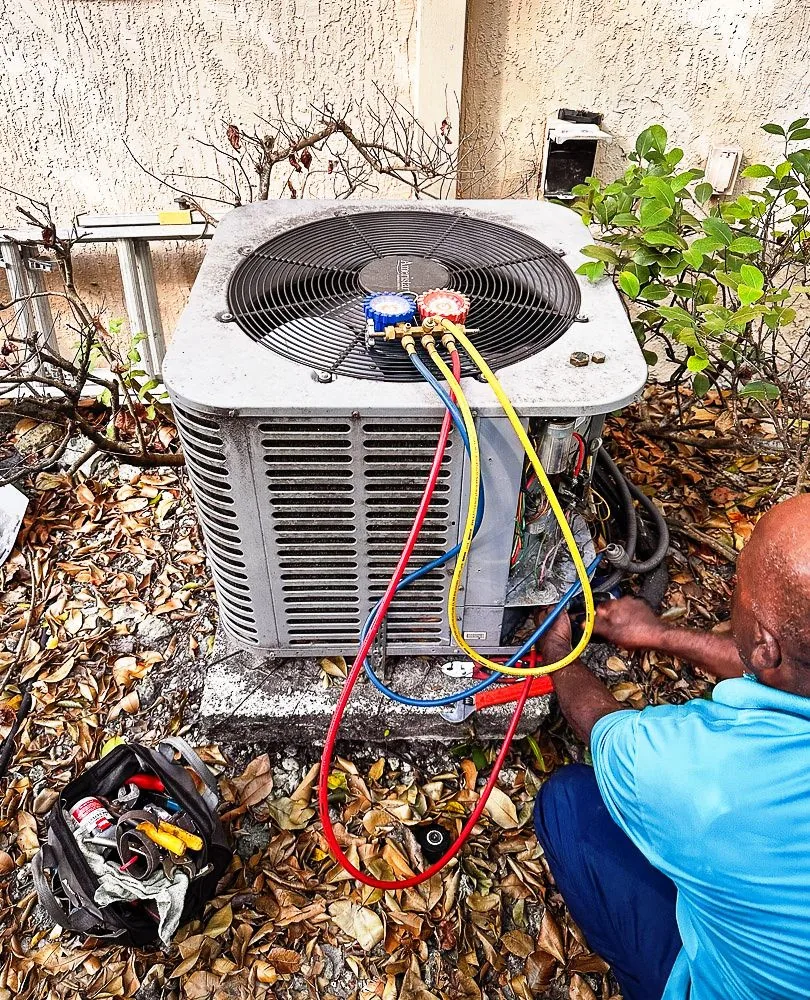
You need a new air conditioner or a major repair. You call a few companies, get a few quotes, and now you have to decide. This should be straightforward — but in Broward County, it is not. Florida has a contractor licensing system, permit requirements, and a very active unlicensed contractor problem. Every year, homeowners across Fort Lauderdale, Tamarac, Coral Springs, and surrounding cities get burned: bad installs, voided warranties, failed inspections, and in some cases, systems that were never permitted and have to be ripped out.
This guide gives you the exact framework to evaluate any HVAC company before you sign anything. Seven questions, a license verification walkthrough, a red flag list, and a side-by-side comparison table. If a contractor cannot pass these basic checks, walk away — there are better options.
Why Contractor Selection Matters More in Florida Than Most States
Florida is not like most states when it comes to HVAC. Here is what makes it different:
Your AC runs year-round. In most of the country, an air conditioner runs four to five months a year. In Broward County, it runs ten to eleven months. That means more stress on the equipment, more hours on every component, and more opportunities for an installation shortcut to become a failure.
Humidity is the real enemy. A system that is slightly oversized or improperly charged will cool the air but will not run long enough to pull moisture out of it. The result is a home that feels clammy, mold that grows behind walls, and air quality problems that are expensive to fix. Proper installation — meaning correct load calculations, accurate refrigerant charge, and sealed ductwork — is the difference between a comfortable home and one that always feels off.
Florida has strict licensing laws, but enforcement is complaint-driven. The state requires HVAC contractors to hold a CAC (Certified Air Conditioning Contractor) or CMC (Certified Mechanical Contractor) license issued by the Florida DBPR. But nobody shows up to check before work starts. The burden is on you to verify before you hire. If something goes wrong with an unlicensed contractor, you have no insurance, no bond, and no state-backed recourse.
Permits are legally required for every installation. No exceptions. A contractor who skips the permit is not saving you money — they are transferring risk to you while saving themselves the administrative work and the inspection that would catch their mistakes.
The 7 Questions Every Homeowner Should Ask (Before Signing Anything)
Print this list out. Ask every contractor you speak with. If any of them cannot answer clearly and confidently, you have your answer.
Are you licensed with the Florida DBPR?
Ask for their license number — not just "yes, we're licensed." A licensed contractor will give you a CAC or CMC number immediately. Write it down and verify it yourself at myfloridalicense.com before you schedule.
Are your technicians NATE-certified?
NATE (North American Technician Excellence) is the industry's gold standard for third-party technician certification. Only about 20% of HVAC techs nationwide hold it. Ask specifically which techs are certified — not just whether the company has any certified employees on staff.
Do you pull the permit for the installation?
This should be automatic and non-negotiable. If the contractor hesitates, says the permit "isn't necessary for a swap," or offers to skip it to save you money, stop the conversation. They are either unlicensed or cutting corners.
What brand of equipment do you install, and what warranty comes with it?
Reputable contractors are authorized dealers for major brands (Carrier, Trane, Lennox, Daikin). Ask specifically what warranty the equipment carries and whether that warranty requires a permitted, licensed install to remain valid. Most do.
What's included in this quote?
A complete quote covers equipment, labor, permits, refrigerant, and disposal of the old unit. If the number looks suspiciously low, ask what it does not include. Hidden costs for refrigerant or permits added after the fact are a common tactic with low-ball operators.
Do you offer a workmanship warranty?
Equipment warranties cover the parts. A workmanship warranty covers the installation — the labor, the connections, the refrigerant charge, the duct sealing. A contractor confident in their work offers both. One year is standard; some offer two.
Can you provide references or show me your Google reviews?
Any established HVAC company in Broward County has a track record. Look for patterns in their Google reviews: are there recurring complaints about no-shows, return visits for the same problem, or billing disputes? Consistent 4.8+ star ratings across hundreds of reviews is a strong signal.
License Verification: How to Check Any Florida HVAC Contractor in 30 Seconds
Do not take a contractor's word for it. The Florida DBPR (Department of Business and Professional Regulation) maintains a public license lookup that takes about thirty seconds to use. Here is exactly how:
- Go to myfloridalicense.com/wl11.asp in your browser.
- Under "License Type," select Certified Contractor from the dropdown.
- Enter the contractor's license number (e.g., CMC1250582) in the License/Certificate Number field, or search by company name.
- Click Search. A valid license will show as Current, Active with an expiration date in the future.
- Confirm the name on the license matches the company you are hiring.
If the license shows as "Null and Void," "Delinquent," "Inactive," or does not appear at all — do not hire them. There is no gray area here.
Florida HVAC contractors need to renew their license every two years. A lapsed license is not a technicality — it means they are operating illegally. For reference, World Air HVAC holds license CMC1250582, which you can verify at that URL right now.
What NATE Certification Actually Means
NATE — North American Technician Excellence — is the HVAC industry's most rigorous third-party certification program. It is not a manufacturer training program or an in-house designation. It is an independent organization that writes and administers exams based on real-world installation and service knowledge.
Technicians must pass specialty exams in specific areas: air conditioning installation, air conditioning service, heat pumps, commercial refrigeration, or gas furnaces. The exams are not easy — they test equipment engineering, refrigerant handling, electrical diagnostics, and proper installation procedures at a level that goes well beyond on-the-job experience.
Here is the number that matters: fewer than 20% of HVAC technicians nationwide hold NATE certification. Most technicians learn their trade through experience, which is valuable — but experience alone does not guarantee they know the right way to charge a system, size ductwork, or calculate heat load for a specific home. NATE certification does.
When you hire a company with NATE-certified technicians, you are getting someone who has been independently tested and verified. All World Air HVAC technicians are NATE-certified. That is a hiring standard we have held since we opened in 2005, and it is a standard most companies in Broward County cannot match.
The Permit Question: Why This Is Non-Negotiable
Every new AC installation in Broward County requires a permit. Not most of them — every single one. The permit triggers a county inspection that verifies the system was installed correctly, the refrigerant was charged properly, and the electrical connections are safe.
Skipping the permit does not just violate local code. It creates a cascade of problems that can follow you for years:
- Manufacturer warranty void. Most major AC manufacturers — Carrier, Trane, Lennox, Daikin — require that installations be completed by a licensed contractor with a pulled permit in order for the equipment warranty to remain valid. If you have an unpermitted install and a compressor fails at year three, your warranty claim can be denied.
- Homeowners insurance complications. If a fire or flood claim involves your HVAC system and the install was unpermitted, your insurer has grounds to dispute or deny the claim.
- Disclosure required on home sale. In Florida, unpermitted work must be disclosed to buyers. It can tank a sale, require expensive remediation, or cost you thousands in price negotiations.
- Code enforcement fines. If an inspector discovers an unpermitted installation, you — the homeowner — are responsible for the fines, even if you did not know the contractor skipped it.
When a contractor tells you they can skip the permit to save you $300, what they are actually doing is saving themselves about three to four hours of administrative work while transferring significant legal and financial risk to you. That is not a deal.
Red Flags That Should Make You Walk Away
After 20 years serving Broward County homeowners, we have heard every story. These are the warning signs that appear consistently before a bad outcome:
- No physical business address or arrives in an unmarked van with no company branding
- Cash-only payment with no written invoice or itemized quote
- "We can start today without pulling permits — saves you $300"
- Quote is significantly lower than all other bids with no explanation for the difference
- High-pressure same-day close: "This price is only good if you sign right now"
- Cannot provide a license number, or the number does not verify on myfloridalicense.com
- No written warranty offered — or warranty terms are vague and verbal only
That last one deserves emphasis. Any contractor who cannot tell you their Florida DBPR license number on the spot is either unlicensed or hoping you will not check. Licensed contractors know their license number the way you know your phone number. It is not something they have to look up.
What a Great Quote Looks Like (vs. a Suspicious One)
A legitimate, comprehensive HVAC quote is a written document. It itemizes every line: equipment model and SEER rating, labor, permit fee, refrigerant, removal and disposal of the old unit, and any accessories like new disconnect boxes or line set. The total is clear and the scope is specific.
A suspicious quote is a round number texted to you after a ten-minute visit. No model number. No SEER rating. No itemization. No mention of permits. Just "$4,800 for a 3-ton system." You do not know what brand, what efficiency, whether the permit is included, or whether the refrigerant charge is part of the deal.
Here is a practical rule: if a quote is 25% or more below every other quote you received, ask why. There is always a reason. The most common ones are builder-grade equipment being passed off as equivalent to a name-brand unit, grey-market equipment with no manufacturer warranty, permits not included, or a plan to up-sell you after the job starts when you have limited options.
Read our fair pricing guide for AC replacement in Broward County to understand what reasonable ranges look like for different system sizes and efficiency tiers before you get your first quote.
Licensed Contractor vs. Unlicensed Handyman — Side by Side
| What You Care About | Licensed & Insured Contractor | Unlicensed / Fly-by-Night |
|---|---|---|
| Equipment warranty | Valid — licensed install required | Voided by most manufacturers |
| Permit pulled | Yes — county inspection included | No — no inspection, no record |
| Insurance coverage | Contractor is bonded and insured | No coverage if something goes wrong |
| Recourse if work fails | State licensing board + written warranty | None — you absorb the cost |
| Home sale impact | Permitted record protects you | Must disclose unpermitted work to buyers |
| Technician qualification | State-licensed, often NATE-certified | Unknown — no independent verification |
| Upfront cost | Higher (reflects full scope) | Lower (risks not priced in) |
World Air HVAC: Our Credentials
We have been based in Tamarac and serving Broward County since 2005 — over 20 years. We are not a franchise or a national chain with local sub-contractors. Every technician who shows up at your home works for World Air, is NATE-certified, and has been trained on our installation standards.
DBPR License #CMC1250582
Verify active status at myfloridalicense.com anytime.
NATE-Certified Technicians
Every tech on every job — not just our senior staff.
Every Install Fully Permitted
We pull every permit. No exceptions, no shortcuts.
Licensed, Insured & Bonded
Full liability and workers' comp coverage on every job.
Carrier, Trane & Lennox Dealer
Authorized dealer for the top three brands in the industry.
10-Year Parts Warranty
On all new system installations with registered equipment.
You can read what our customers say on our reviews page — over 500 Google reviews from Broward homeowners. Or learn more about World Air and why we have stayed in the same community for two decades. If you are considering AC installation services, we would be glad to walk you through the process, give you an itemized quote, and let you verify everything before you decide.
We also offer the Comfort Club maintenance plan, which covers two bi-annual tune-ups per year, priority scheduling, and discounts on repairs — a smart way to keep any system running efficiently once you have made the investment of a new install.
Ready to Get a Quote from a Licensed, NATE-Certified Contractor?
No pressure. No same-day close tactics. Just a straight answer on what your home needs and what it will cost — with everything in writing.
Frequently Asked Questions
How do I verify an HVAC contractor's license in Florida?
Go to myfloridalicense.com/wl11.asp, select "Certified Contractor" from the license type dropdown, and enter the contractor's license number or company name. A valid Florida HVAC contractor holds a CAC (Certified Air Conditioning Contractor) or CMC (Certified Mechanical Contractor) license. If the license shows as inactive, delinquent, or does not appear, do not hire them. This check takes about 30 seconds and can save you thousands of dollars.
Do HVAC contractors in Broward County need to pull permits for AC installations?
Yes, without exception. Every new AC installation in Broward County requires a permit pulled by the licensed contractor. A contractor who offers to skip the permit is not doing you a favor. Without a permit, your manufacturer warranty can be voided, your homeowners insurance may not cover a related claim, and you may face fines and remediation costs if you sell your home. The permit fee is typically $100–$300 and should already be included in any legitimate quote.
What does NATE certification mean for HVAC technicians?
NATE (North American Technician Excellence) is the industry's most respected independent certification for HVAC technicians. It requires passing rigorous exams in specific disciplines: AC installation, AC service, heat pumps, and others. Only about 20% of HVAC technicians nationwide hold NATE certification. A NATE-certified technician has demonstrated knowledge beyond on-the-job experience — they understand equipment engineering, proper refrigerant charging, load calculations, and installation procedures at a documented, tested level.
