You had a 4-point inspection done, or your insurance renewal letter arrived with an unfamiliar line item, and now you have two words staring back at you: Federal Pacific or Zinsco. Maybe a contractor mentioned it in passing years ago and you filed it away as sales talk. Now your insurer wants an answer, and you want to know one thing before you spend a dollar: is this real, or is someone trying to scare you into a job you don’t need?
It’s real. Federal Pacific Electric (FPE) Stab-Lok panels and Zinsco panels are two of a small handful of electrical panel brands with a documented history of breakers that fail to trip when they’re supposed to — and Florida’s insurance market has responded accordingly. This is not a random electrician inventing a problem to sell you a panel. It is a known issue that has been showing up in inspection reports and insurance underwriting guidelines for years.
Here is what these panels actually are, what the evidence says about them, why your insurer cares, and what a real replacement costs in Broward County — no scare tactics, no invented numbers.
What Federal Pacific and Zinsco Panels Actually Are
Both brands were common in residential construction from roughly the 1950s through the 1980s, which means they are still sitting in the walls of a large share of Broward County’s older housing stock — the same 1970s-1990s neighborhoods where 100-amp and 150-amp panels generally show up too. The problem isn’t their age alone. It’s a specific mechanical defect in how each brand’s breakers are built.
Federal Pacific Electric (FPE) Stab-Lok
The U.S. Consumer Product Safety Commission (CPSC) investigated FPE Stab-Lok breakers for two years after reports of breakers failing to trip during overloads. Contract testing performed as part of that investigation, evaluating FPE two-pole breakers, documented failure rates ranging from roughly a quarter to nearly two-thirds depending on the breaker rating and test conditions — in some individual-pole tests, failures reached the 50-65% range. A circuit breaker exists to trip and cut power the moment a circuit is overloaded. A breaker that stays closed under those conditions allows wiring to keep overheating instead, which is exactly the fire risk it was installed to prevent.
The CPSC closed its investigation in 1983 without issuing a formal product recall. That is the detail that confuses a lot of homeowners: no recall exists, so it’s reasonable to wonder whether the danger is overstated. But the absence of a recall reflects how the CPSC’s legal recall standard works, not a finding that the breakers are safe — the underlying test data showing high failure-to-trip rates was never disputed, and it’s the same data the home inspection and insurance industries still cite today.
Zinsco (and Later Sylvania-Labeled Zinsco Panels)
Zinsco’s defect is mechanical rather than electronic. Its breakers attach to the panel’s bus bar with an aluminum, horseshoe-shaped clip instead of a bolted or spring-loaded steel connection. Over years of normal heating and cooling cycles, that clip can loosen, arc, and oxidize — and aluminum oxide is an electrical insulator, so the connection gets hotter and more resistant in a self-reinforcing cycle. In advanced cases, the breaker can literally fuse to the bus bar. When that happens, the circuit can stay energized even with the breaker switched to the “off” position, and the breaker loses its ability to trip during an overload at all.
Challenger Panels
Challenger panels are frequently grouped with FPE and Zinsco because they share some of the same breaker compatibility issues and a documented history of connection problems, and Florida insurers commonly flag all three brands during underwriting. If your 4-point inspection or insurance letter names Challenger specifically, treat it the same way you’d treat an FPE or Zinsco finding.
The most dangerous failure mode on a fused Zinsco breaker is that the switch position stops reflecting reality. You can flip a breaker to “off” to work on a circuit and the circuit can still be live. If you have a Zinsco panel and any doubt about a circuit’s status, treat it as energized and call a licensed electrician — do not rely on the breaker position alone.
How Homeowners Usually Find Out They Have One
Almost nobody goes looking for this problem. It surfaces in one of three ways.
1. The 4-Point Inspection
Most Florida insurers require a passing 4-point inspection — roof, electrical, plumbing, and HVAC — before they’ll write or renew a policy on a home 20 years or older. The electrical section of that inspection specifically checks the panel brand, and an FPE, Zinsco, or Challenger panel is one of the most common items that causes a 4-point inspection to fail outright.
2. An Insurance Renewal Notice
If your carrier reinspects periodically, or if you switch carriers and a new 4-point is required, the panel can surface years after you moved in with no warning. The letter usually gives you a window — often 30 to 60 days — to correct the issue before non-renewal takes effect.
3. Visual Identification
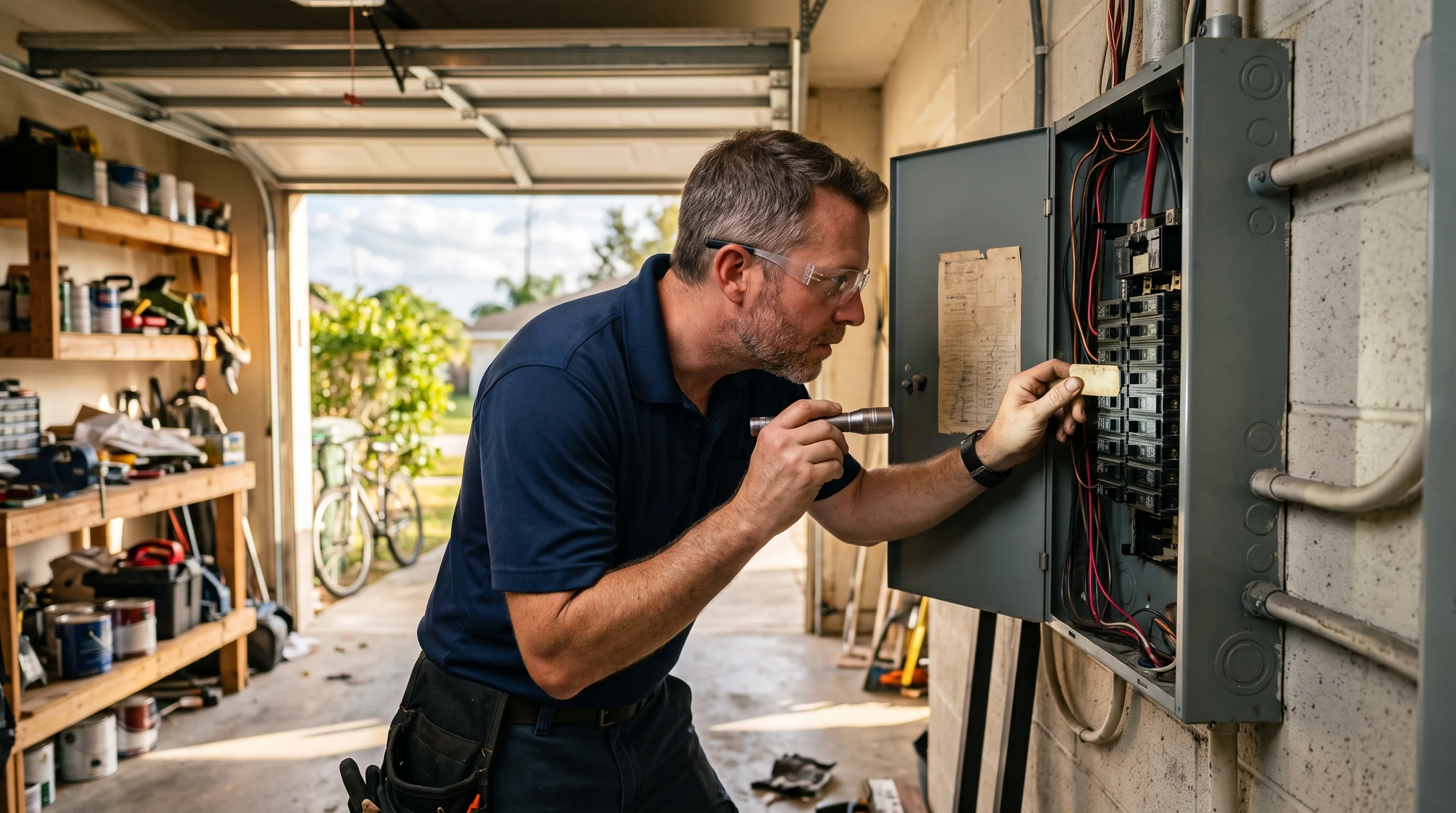
You can check this yourself without touching anything inside the panel. Open the panel door and look at the nameplate, usually printed on the inside of the door or across the top row of breakers. FPE panels typically read “Federal Pacific Electric” or “FPE” with a red, white, and blue Stab-Lok label. Zinsco panels are labeled “Zinsco,” and later production runs sometimes carry the “Sylvania” name instead after a company acquisition. If you’re not sure what you’re looking at, don’t guess — a licensed electrician can identify it in a few minutes during a routine visit.
What Florida Insurers Are Actually Doing About It
This is the part that catches homeowners off guard: it isn’t one insurer being cautious. It’s become close to industry-standard practice across Florida’s private homeowners insurance market. Insurance companies are increasingly refusing to cover homes with Federal Pacific, Zinsco, or Challenger panels, and a growing number of carriers won’t write a new policy at all until the panel is replaced.
When a private carrier declines or non-renews over a flagged panel, homeowners are often pushed toward Citizens Property Insurance Corporation — Florida’s state-backed insurer of last resort — or toward surplus-lines coverage, both of which typically cost more than standard private-market policies. Citizens exists specifically to cover homes the private market won’t touch, and a flagged panel is one of the more common reasons a homeowner ends up there.
From an underwriting standpoint, this isn’t personal. A panel with a documented, elevated failure-to-trip rate is a higher statistical fire risk, full stop. Insurers price and decline risk based on data like this across their entire book of business — not based on how well-maintained your specific home looks.
The only fix that satisfies underwriting across the board is replacing the panel. Cleaning it, relabeling breakers, or having an electrician “service” the existing FPE or Zinsco equipment doesn’t change the brand on file, and it won’t change the inspection result on your next 4-point.
The Real Cost to Replace a Federal Pacific or Zinsco Panel
A full panel replacement is the same scope of work whether the trigger is age, capacity, or an insurance flag. In Tamarac and the surrounding Broward County area, a standard 200-amp panel upgrade runs $1,800–$3,500 installed, depending on your home’s existing wiring condition, whether the meter base also needs to be replaced, and any code compliance updates required along the way.
That price includes:
- Full assessment of your existing panel and wiring before work begins
- Removal of the old FPE, Zinsco, or Challenger panel
- Installation of a new 200-amp panel (400-amp for larger homes) with modern arc-fault and ground-fault breakers
- Meter base replacement if required by FPL or your utility provider
- Labeling of all circuits for easy identification
- The required Broward County permit and inspection coordination
- A final walkthrough on how to safely operate your new panel
Because these panels are a documented safety issue, World Air HVAC recommends replacing an FPE, Zinsco, or Challenger panel regardless of your current electrical needs — not just when it’s time to add a circuit or upgrade capacity. If your home is also older wiring, a panel replacement is frequently the right moment to add whole-house surge protection at the same time, since the protection device installs directly at the panel and Broward County’s lightning frequency makes it a natural pairing with the same service call.
It’s also worth planning ahead if you know a larger electrical project is coming. Homeowners adding a Level 2 EV charger or a new high-efficiency AC system often need the added capacity a modern 200-amp panel provides anyway — in those cases, replacing a flagged FPE or Zinsco panel and adding the new circuit in the same visit is more efficient than scheduling two separate jobs.
The Permit Isn’t Optional — and Skipping It Defeats the Purpose
Panel replacement requires a permit and inspection in Tamarac and throughout Broward County, the same as most other electrical work involving new circuits or a service upgrade. A licensed electrician pulls the permit before work starts, completes the installation, and coordinates the final inspection with the local building department.
If you’re replacing a panel specifically to satisfy an insurance requirement, an unpermitted swap can undermine the entire point. Insurers and 4-point inspectors both check for permit records on panel work, and an unpermitted replacement can raise the same red flag the old panel did — on top of leaving the work without an independent inspection to confirm it was done correctly.
Ask any electrician quoting the job whether the permit fee is included in the price, and confirm they’ll handle the inspection scheduling. That should be standard, not an upcharge.
What to Do Next
If your 4-point inspection or insurance renewal flagged a Federal Pacific, Zinsco, or Challenger panel, here’s the practical sequence:
- Confirm the brand. Open the panel door and check the nameplate, or have an electrician confirm it during a short visit — don’t assume based on a verbal report alone.
- Get an itemized quote. It should specify the panel amperage, breaker count, meter base work if needed, and the permit fee as a line item.
- Check your insurer’s deadline. Non-renewal notices usually specify a window to complete the replacement and provide documentation. Schedule with that date in mind, not the other way around.
- Get the permit closed, not just the work done. Ask your electrician to confirm the final inspection has passed before you submit documentation to your insurer.
An FPE or Zinsco panel flag is not a scam, and it’s not something a routine cleaning or breaker swap will resolve. It’s a documented, decades-old defect that Florida’s insurance market has priced accordingly. The fix is straightforward, it’s a known cost, and once it’s permitted and inspected, it’s off your list for good.
Frequently Asked Questions
Is a Federal Pacific or Zinsco panel actually dangerous, or is this just an upsell?
It is a documented issue, not a sales tactic. The Consumer Product Safety Commission investigated Federal Pacific Electric Stab-Lok breakers for two years; contract testing during that investigation found failure-to-trip rates as high as 51 to 65 percent on some breaker types. Zinsco panels have a separate, well-documented defect where the breaker’s connection to the bus bar corrodes and can fuse permanently, sometimes leaving a circuit energized even when the breaker is switched off. Neither product has ever been formally recalled, which is why so many are still in service decades later.
Will my Florida homeowners insurance really drop me over an electrical panel brand?
Yes. Most Florida homes 20 years or older are required to pass a 4-point inspection before a carrier will write or renew a policy, and a Federal Pacific, Zinsco, or Challenger panel is one of the most common reasons that inspection fails. Private carriers routinely decline to write new coverage or non-renew existing policies once the panel is flagged, which pushes homeowners toward Citizens Property Insurance Corporation, Florida’s insurer of last resort, or surplus-lines coverage at a higher premium. Replacing the panel is the only fix that satisfies underwriting across the board.
How much does it cost to replace a Federal Pacific or Zinsco panel in Broward County?
A standard 200-amp panel replacement in Tamarac and the surrounding Broward County area typically runs $1,800–$3,500. That price includes the new panel, new breakers, labor, the required permit, and the post-installation inspection. The exact figure depends on your home’s existing wiring condition and whether the meter base also needs to be replaced.
Do I need a permit to replace my electrical panel in Tamarac?
Yes. Panel replacement requires a permit and inspection in Tamarac and throughout Broward County. A licensed electrician pulls the permit, completes the work, and coordinates the final inspection. An unpermitted panel swap can create the exact same insurance problem you were trying to solve, since insurers and buyers’ inspectors both check for permit history on electrical work.
How do I find out what brand my electrical panel is?
Open the panel door (do not touch anything inside) and look at the nameplate, usually printed on the inside of the door or across the top of the breaker rows. Federal Pacific panels typically say “Federal Pacific Electric” or “FPE” with a red, white, and blue Stab-Lok label. Zinsco panels are labeled “Zinsco” or, on some later units, “Sylvania.” If you are not comfortable opening the panel or the labeling is unclear, a licensed electrician can identify it during a short visual inspection.
