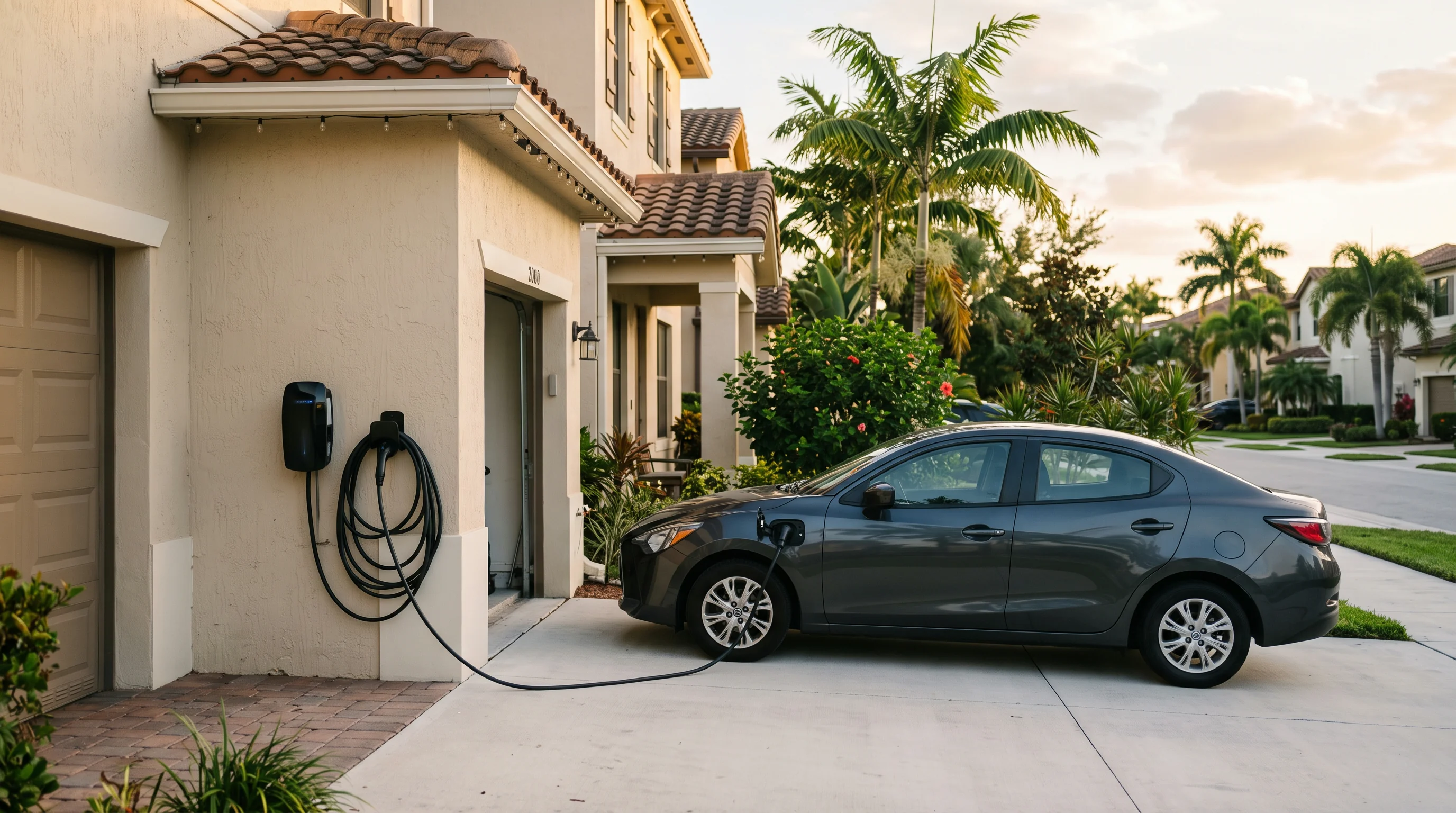
Broward County has one of the highest concentrations of condominiums and HOA-governed communities in Florida. If you live in one of them and you need to replace an aging AC system or you want to install an EV charger, there is a good chance your first call is not to a contractor — it is to your board, wondering whether they can even say no.
Here is the short version: your board has real authority, but it is not unlimited. Florida law draws a real line between what a condominium or homeowners’ association can restrict for aesthetic and safety reasons, and what it is legally prohibited from blocking outright. That line is different for condos than it is for HOAs, and it is different again for AC replacement than it is for EV chargers. Most of the confusion homeowners run into comes from not knowing which rule applies to which situation.
This guide walks through what Florida Statutes 718.113 (condominiums) and 720.3075 / 720.3035 (homeowners’ associations) actually say, what your board can still legitimately require, and what a realistic approval process looks like. This is not a pricing guide — for AC replacement cost breakdowns, see our AC replacement cost guide, and for EV charger installation cost, see our EV charger installation cost guide. This post is specifically about the board approval process and what state law protects.
Condo or HOA? Two Different Chapters of Florida Law Apply
The single most important fact in this entire topic is that “HOA rules” and “condo rules” are governed by two different chapters of the Florida Statutes, and they do not protect owners equally.
- Condominiums are governed by Chapter 718, the Condominium Act. Your unit sits inside a building where the walls, roof, and exterior grounds are typically common elements owned collectively, and your AC condenser or EV charging space is usually located on a limited common element or an exclusively designated parking space assigned to your unit.
- Homeowners’ associations (HOAs) governing single-family homes, townhomes, and villas are governed by Chapter 720, the Homeowners’ Association Act. You typically own your lot and the structure on it outright, and the association’s authority comes from the declaration of covenants and its architectural review process, not from common-element ownership.
As you will see below, Chapter 718 gives condo owners a specific, named statutory right to install an EV charger. Chapter 720 does not contain an equivalent right for HOA homeowners. That asymmetry surprises a lot of people, and it is the reason a blanket answer like “Florida law protects your right to an EV charger” is not accurate for every Broward homeowner — it depends entirely on which type of community you live in.
What Your Board Can Legally Restrict — and What It Cannot
Boards are not powerless, and they should not be. Reasonable architectural review protects property values and prevents one owner’s DIY wiring job from becoming everyone’s fire risk. But that authority has to come from somewhere specific.
For HOAs, Florida Statute 720.3035(1)(a) is explicit about the source of that authority: an association’s power to review and approve the location, size, type, or appearance of any improvement on a parcel “shall be permitted only to the extent that the authority is specifically stated or reasonably inferred as to such location, size, type, or appearance in the declaration of covenants or other published guidelines and standards authorized by the declaration of covenants.” The same statute requires the association to “reasonably and equitably apply and enforce” those standards on every owner — not selectively.
In practice, that means:
- Your board can require compliance with building and safety codes, use of a licensed contractor, review of equipment that is visible from the street or a neighboring parcel, and conformance with dimension, placement, and appearance standards that are actually written down in the declaration or published architectural guidelines.
- Your board generally cannot deny a request based on an unwritten preference, apply a rule to you that it does not apply to your neighbor, or — for the two specific situations covered later in this guide — flatly prohibit an EV charger in a condo, or require review of a hidden, substantially-similar AC system in an HOA home.
Every community’s declaration of covenants, bylaws, and architectural guidelines are different. Florida Statutes set the floor for what your board cannot do, but your specific declaration may grant the board additional discretion within that floor. Before you assume a statute overrides your community’s process, pull your governing documents and read the architectural review section.
AC Replacement: What Florida Law Actually Protects
AC replacement does not come with a dedicated statutory right the way EV chargers do for condo owners. Instead, it is governed by the general architectural review rules described above — with one meaningful exception that HOA homeowners specifically get and condo owners do not.
HOA Homes: The “Hidden System” Carve-Out
Florida Statute 720.3035(1)(b)2 says an HOA cannot enforce a covenant that would require review and approval of a “central air-conditioning, refrigeration, heating, or ventilating system” if that system is not visible from the parcel’s frontage, an adjacent parcel, an adjacent common area, or a community golf course, and it is substantially similar to a system that is approved or recommended by the association.
In plain terms: if your condenser sits in the same side-yard pad it has always sat in, out of view from the street and your neighbors, and the replacement is a comparable residential system rather than something wildly different in size or type, your HOA cannot legally require you to submit it for architectural review at all. That is a real, specific protection — and one most Broward homeowners in HOA communities do not know exists.
It is not unlimited. If your new system relocates the condenser somewhere it is now visible from the street, changes to a different type of equipment (a heat pump where there was a straight AC, for example, or an outdoor unit dramatically different in footprint), or your existing declaration defines “visible” or “substantially similar” in a way your specific project doesn’t meet, review can still apply.
Condominiums: Governed by the Declaration’s Material Alteration Rules
Condos do not have an equivalent statutory carve-out for hidden AC systems, because condo AC equipment is more often located on a balcony, in a mechanical closet, or on common-element grounds shared by the building — not on a private lot with a defined “frontage.” Instead, AC replacement in a condo is generally governed by your declaration’s material alteration provisions, which typically require board approval (and sometimes a unit owner vote, depending on how your specific declaration defines a material alteration to the common elements or limited common elements).
The practical upshot: a like-for-like swap of equipment in the same location, using the same size unit, is far less likely to be treated as a material alteration than a change in unit type, size, or location. Always confirm with your board or management company before scheduling installation, and get the approval in writing.
Whether you are in an HOA or a condo, keep the model number, tonnage, and physical footprint of your old system, and compare it to your new system’s specs before you submit anything to the board. If the new unit is the same tonnage in the same location, you have a documented case that it qualifies as substantially similar — which matters under Section 720.3035 for HOA homes, and helps your case with a condo board even where the statute doesn’t apply directly.
Our AC replacement cost guide covers what a Broward County replacement actually runs by system size, and what should be included in an itemized quote — useful context to have before you go to your board with a project.
EV Chargers: Where Condo Owners Have Real Statutory Teeth
This is where Florida law is most direct — and most different depending on whether you own a condo unit or an HOA-governed home.
Condominiums: Florida Statute 718.113(8)
Section 718.113(8) states that a declaration of condominium or restrictive covenant “may not prohibit or be enforced so as to prohibit” a unit owner from installing an electric vehicle charging station within the boundaries of that owner’s limited common element or exclusively designated parking area. That is a direct override of any provision in your declaration that would flatly ban EV chargers.
The right comes with real conditions the owner has to meet:
- The installation cannot cause irreparable damage to the condominium property.
- Electricity used by the charger must be separately metered or metered through an embedded meter, and the cost is the unit owner’s responsibility.
- The owner bears the full cost of installation, operation, maintenance, and repair, including hazard and liability insurance.
- The owner must comply with all applicable federal, state, and local laws and regulations.
And the board retains real, legitimate authority over how it happens — it can require:
- Compliance with bona fide safety requirements consistent with applicable building codes.
- Reasonable architectural standards, adopted by the association, governing the dimensions, placement, or external appearance of the charging equipment.
- Installation by a licensed and registered contractor.
- A certificate of insurance within 14 days after the association approves the installation.
- Reimbursement for any documented increase in the association’s insurance premium directly attributable to the charging station.
Separately, Florida Statute 718.113(9) allows the board itself to install and operate EV charging stations on the condominium’s common elements or association property and to charge unit owners, residents, or guests for using them — and doing so is not treated as a material alteration requiring a unit owner vote.
HOA Homes: No Equivalent Statutory Right (as of 2026)
This is the part that catches HOA homeowners off guard. Florida Statute 720.3075(3), the HOA equivalent of the condo statute, lists specific things an association cannot restrict — the display of certain flags, certain fuel and energy source choices tied to utility service, use of certain grills or appliances, parking your own personal vehicle in your own driveway, hiring a properly performing but unlicensed contractor, and operating a vehicle in conformance with state traffic laws. Electric vehicle charging stations are not on that list.
Condo owners have a specific Florida statute that overrides a flat EV charger ban in their declaration. HOA homeowners governed by Chapter 720 do not have that same override as of 2026. If you live in an HOA community and want an EV charger, your request is evaluated under your declaration and architectural review process — the same general framework covered above for AC replacement, not a specific statutory guarantee. Check your governing documents, and don’t assume the condo rule applies to you.
For what a Level 2 home charger installation actually costs in Broward County once you have board sign-off, see our EV charger installation cost guide. World Air HVAC handles the electrical panel evaluation, dedicated circuit, charger mounting, and permit filing with Broward County — the technical side of the project once your board approves it. For the full scope of what our electricians handle on an EV charger install, see our electrical services page.
The Practical Approval Process: What to Expect and How Long It Takes
Neither Chapter 718 nor Chapter 720 sets a specific deadline for a board to approve or deny an EV charger or AC replacement request. There is no statutory “deemed approved if they don’t respond in X days” clock for either project type. That means the timeline you should expect is whatever your community’s architectural review process says it is — which varies widely between a self-managed 40-unit condo and a professionally managed HOA with a monthly ARC meeting schedule.
A realistic process generally looks like this:
- Submit a written application with equipment specs, model number, contractor license information, and a site plan or photo showing placement — most associations require this in writing regardless of statute.
- Board or ARC (architectural review committee) review, which may happen at a regular meeting or via a standing delegated approval process, depending on your declaration.
- Written approval or denial, ideally with any conditions (aesthetic standards, insurance requirements, contractor licensing) spelled out.
- Permit and installation — once you have board approval, World Air HVAC pulls the Broward County mechanical or electrical permit and schedules the work.
For residential condominiums specifically, Florida Statute 718.112(2)(a) gives you a genuine tool if your board goes quiet: send your inquiry by certified mail, and the board must provide a substantive written response within 30 days — or within 60 days if it needs to obtain a legal opinion first. This is a general communication right under Chapter 718, not an EV- or AC-specific approval deadline, and it does not apply to HOAs under Chapter 720. But it is a real, usable escalation step if a condo board is simply not responding.
If Your Board Unreasonably Denies You
If your condo board flatly denies an EV charger request that meets the conditions in Section 718.113(8), or your HOA insists on reviewing an AC system that meets the hidden, substantially-similar test in Section 720.3035(1)(b)2, start with the basics: get the denial in writing, ask for the specific declaration provision or architectural standard the board relied on, and confirm whether that standard was actually adopted and published, or is simply an unwritten preference.
Many condo and HOA disputes in Florida are required to go through a pre-suit mediation or arbitration step before litigation, and the exact process depends on the type of association and the nature of the dispute. This is genuinely a point where a phone call to a Florida attorney who handles community association law is worth more than anything a contractor or a blog post can tell you — the right process depends on your specific declaration and the type of association you live in.
Everything in this guide is based on our reading of the current Florida Statutes and is intended to help you understand the general framework before you talk to your board. It is not a substitute for reading your specific declaration of covenants and bylaws, and it is not legal advice. If you have an active dispute with your association, consult your governing documents and a Florida attorney who handles condominium or homeowners’ association law.
Frequently Asked Questions
Can my condo association legally stop me from installing an EV charger in Broward County?
No, not outright. Florida Statute 718.113(8) says a declaration of condominium or restrictive covenant may not prohibit a unit owner from installing an electric vehicle charging station within the boundaries of their limited common element or exclusively designated parking area. The board can still require bona fide safety compliance, reasonable architectural standards on dimensions, placement, and appearance, a licensed and registered installer, and proof of insurance within 14 days of approval — but it cannot say no simply because it does not want an EV charger on the property.
Does the same law protect HOA homeowners who want an EV charger?
Not to the same degree. Chapter 720, the Florida Homeowners’ Association Act, does not contain a provision parallel to Section 718.113(8). Florida Statute 720.3075(3) lists specific things an HOA cannot restrict — flags, certain fuel and energy choices, parking your own vehicle in your own driveway, hiring a properly qualified but unlicensed worker, and operating a vehicle in conformance with traffic law — but electric vehicle charging stations are not on that list. If you live in an HOA-governed single-family home rather than a condominium, your EV charger request is generally evaluated under your community’s declaration and architectural review process, not a specific statutory override.
Can my HOA make me get board approval before replacing my AC unit?
Usually yes, in principle — but Florida Statute 720.3035 limits how far that authority reaches. Under 720.3035(1)(a), an association’s architectural review authority is only as broad as what is specifically stated or reasonably inferred in the declaration of covenants, and must be applied reasonably and equitably to every owner. Under 720.3035(1)(b)2, an association cannot require review and approval of a central air-conditioning, refrigeration, heating, or ventilating system if it is not visible from the parcel’s frontage, an adjacent parcel, an adjacent common area, or a community golf course, and is substantially similar to a system the association has already approved or recommends. A like-for-like condenser swap in the same side-yard pad, out of street view, often falls into that protected category.
How long does my board have to approve or deny my request?
Neither Florida Statute 718.113 nor Chapter 720 sets a specific deadline for a board to approve or deny an EV charger or AC replacement request. What does exist, for residential condominiums only, is Florida Statute 718.112(2)(a): if you send the board a written inquiry by certified mail, the board must give you a substantive written response within 30 days, or within 60 days if it needs a legal opinion first. That is a general communication right, not an EV- or AC-specific approval clock, but it is a real tool for getting a stalled board on the record.
What can my board still legally require for an EV charger installation?
For condominiums, Florida Statute 718.113(8) allows the board to require compliance with bona fide safety requirements consistent with applicable building codes, reasonable architectural standards governing the dimensions, placement, or external appearance of the equipment, installation by a licensed and registered contractor, proof of insurance within 14 days after approval, and reimbursement for any documented increase in the association’s insurance premium attributable to the charger. What the board cannot do is deny the request outright or use unwritten, inconsistently applied preferences instead of adopted standards.
