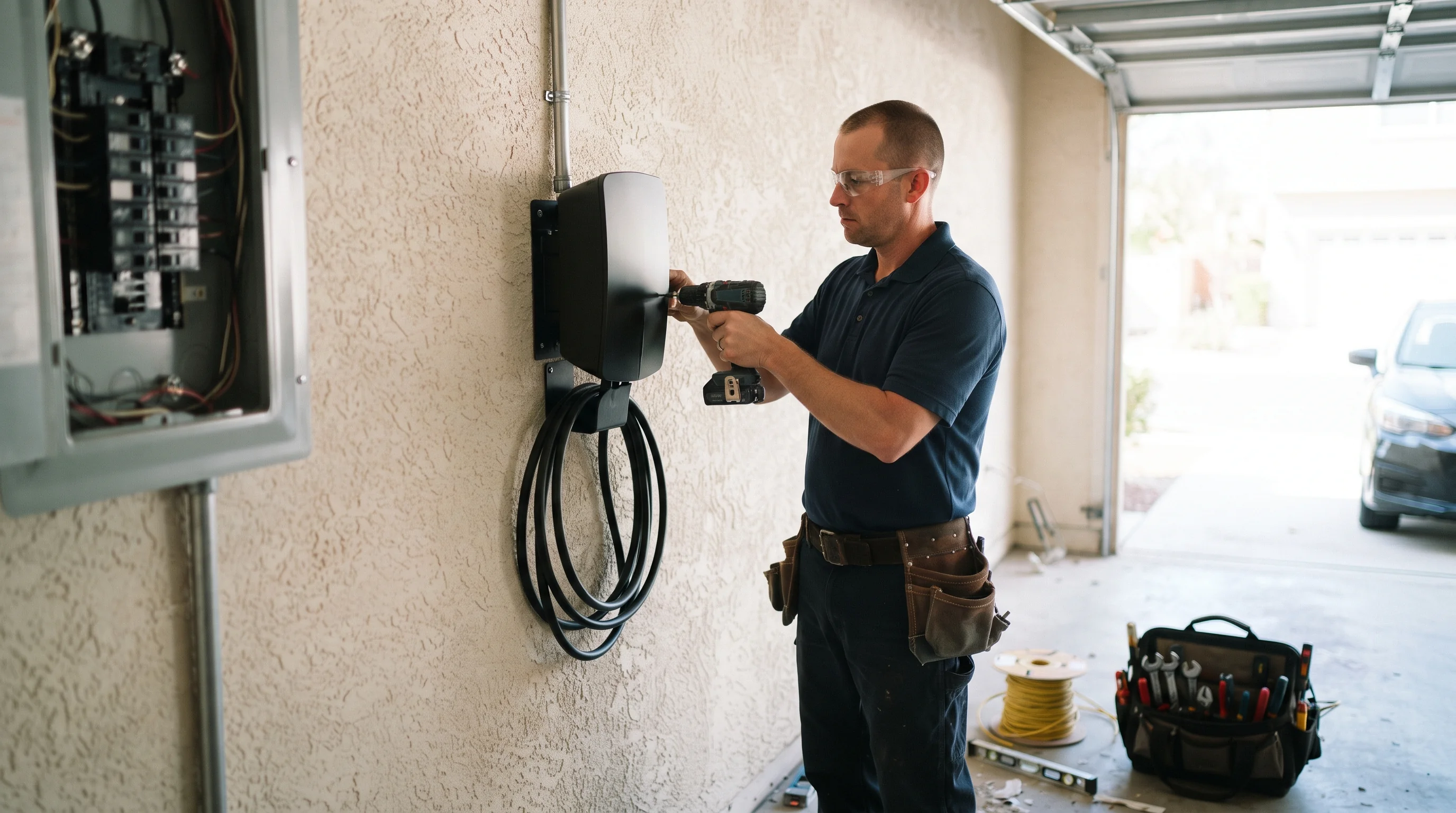
You just bought an EV, or you are about to, and now you are staring at your garage wall wondering what it actually takes to charge it at home. The honest answer starts with a question most people do not think to ask first: does your electrical panel have room for it?
Everything about your EV charger installation — the cost, the timeline, whether a permit inspector visits once or twice — comes down to that single question. A home with a modern 200-amp panel and an attached garage near the electrical service is a straightforward afternoon job. A home with an older 100-amp panel, or a charger location on the far side of the driveway, is a different project entirely.
This guide walks through what a Level 2 install actually involves, what genuinely moves the price, and the permit process every Broward County municipality — including Tamarac and Fort Lauderdale — requires before that circuit can be energized.
What a Level 2 EV Charger Installation Actually Involves
A Level 2 charger runs on a 240-volt circuit — the same voltage class as your dryer or range — and delivers a full overnight charge in 4 to 8 hours, compared to 24 to 48 hours plugged into a standard 120-volt outlet. For anyone who drives daily and wants to wake up to a full battery, Level 2 is the only setup that makes sense long-term.
A proper installation is not just mounting a box on the wall. The process runs in this order:
- Panel capacity evaluation. The electrician checks your panel's total rated capacity against your existing loads — AC, water heater, dryer, range, pool equipment — to confirm there is room for a new 40 or 50-amp circuit.
- Dedicated circuit run. A new circuit is run from the panel to your charging location, sized to the charger's amperage draw per National Electrical Code Article 625, which governs EV charging equipment.
- Mounting. The charger unit is mounted at the correct height and distance from your vehicle's charge port, whether that is a garage wall, a carport post, or an exterior driveway location.
- Testing. The completed circuit is tested for correct voltage, amperage, and ground fault protection before the charger is put into service.
- Permit filing and inspection. The permit is filed with the relevant Broward County municipality, and the finished work is inspected before final sign-off.
- Walkthrough. You get a rundown of the charger's scheduling, amperage settings, and any app-based features before the electrician leaves.
A standard install with an adequate panel and a reasonably short circuit run takes 3 to 5 hours. If your panel needs to be upgraded first, plan on adding roughly half a day to the project.
What Actually Drives the Cost: Panel Capacity Is the #1 Swing Factor
Here is the part most cost guides gloss over: the charger and its dedicated circuit are only one piece of the bill. The single biggest variable in what you will actually pay is whether your existing panel has room for the new circuit, or whether it needs to be upgraded first.
We are not going to hand you a single made-up "installed price" for an EV charger, because it genuinely depends on that panel question — and on secondary factors like circuit distance and charger location. What we can give you is the real cost components, sourced honestly, so you know what you are pricing out.
| Cost Component | What It Covers | Typical Range | Source |
|---|---|---|---|
| Charger hardware | The Level 2 EVSE unit itself (Tesla, ChargePoint, JuiceBox, etc.) | $380 – $690 | DOE Alternative Fuels Data Center, citing Rocky Mountain Institute |
| Install materials | Circuit wiring, breaker, conduit — per connector, before labor | ≈ $1,300 | DOE Alternative Fuels Data Center, citing NREL/INL research |
| Panel upgrade If Needed | 200-amp panel replacement, breakers, labor, permit & inspection | $1,800 – $3,500 | World Air HVAC published electrical pricing |
| Labor | Circuit run, mounting, testing — varies by distance and access | Quoted on-site | Varies by home |
The figures from the DOE's Alternative Fuels Data Center are national data points, not a Broward County quote — they exist to show you roughly what the charger and its wiring materials cost before a Broward electrician's labor and a local permit fee are added. The panel upgrade figure is the one number in that table we can speak to directly, because it is our own published pricing for the work we do most often as a prerequisite to EV charger installs in Broward County. Your actual total is the sum of whichever rows apply to your home, which is exactly why we evaluate your panel on-site before quoting a number.
If your home still has a Federal Pacific, Zinsco, or Challenger panel, budget for a replacement before an EV charger circuit is even on the table. These panels have documented failure rates where breakers do not trip during overloads, and most electricians — us included — will not add a high-draw circuit like an EV charger onto one. If that describes your panel, our guide to Federal Pacific and Zinsco panels in Broward County covers why insurers are increasingly flagging them too.
Beyond the panel question, two smaller factors move the price: how far your charging location sits from the panel (a detached garage or the far end of a long driveway means more wire and more labor), and whether the mounting surface requires extra prep, like exterior stucco or a freestanding pedestal instead of a garage wall.
The Permit Process for EV Chargers in Broward County
Adding a new 240-volt circuit is electrical work, and electrical work requires a permit in every Broward County municipality — there is no like-for-like exemption the way there sometimes is for simple fixture swaps. This applies whether you are in Tamarac, Fort Lauderdale, Coral Springs, or anywhere else in the county.
In Fort Lauderdale specifically, permit applications and inspection scheduling run through the city's LauderBuild portal, and the filing has to be submitted by a Florida-licensed, city-registered electrical contractor — not the homeowner. What the application generally requires:
- The charger's make, model, and electrical specifications
- The proposed circuit amperage and wire gauge
- The installation location on the property
Once the circuit is installed, a building inspector verifies the work before it is approved for permanent use. Broward's High-Velocity Hurricane Zone designation also means outdoor-mounted equipment — a charger on an exterior wall or a freestanding pedestal near a driveway — gets held to stricter mounting and weatherproofing standards than you would see in most of the country.
If a contractor tells you an EV charger circuit does not need a permit because "it's just an outlet," that is incorrect for a dedicated 40 or 50-amp EV circuit. Skipping the permit risks an insurance denial if the wiring is ever involved in a fire or water claim, and it can surface as an unpermitted-work flag when you sell the home.
If You Live in a Condo or HOA Community
Florida Statute 718.113(8) gives condominium unit owners a real legal right here: a condo association's board cannot deny a properly submitted request to install an EV charging station in your assigned parking space, as long as the installation meets code and does not cause irreparable damage to the property. You are responsible for the installation cost, a separate meter or sub-meter for the electricity, and ongoing maintenance — but the board cannot simply say no. HOAs governing single-family and townhome communities operate under a related but distinct statute with its own conditions. Because the approval paperwork, timelines, and what counts as a "properly submitted" request are their own can of worms, we cover that in detail in our guide to HOA and condo rules for AC and EV chargers in Broward County.
Choosing a Charger: Brand Comparison Notes
We install all of the major Level 2 charger brands, and the right pick usually comes down to your vehicle, your budget, and whether you want app-based scheduling: Tesla Wall Connector, ChargePoint Home Flex, JuiceBox, Grizzl-E, Wallbox Pulsar Plus, and Emporia.
- Tesla Wall Connector is the natural choice for Tesla owners, with the tightest integration to the vehicle's charging software, though it also supports other EVs via an adapter.
- ChargePoint Home Flex and Wallbox Pulsar Plus are adjustable-amperage units with strong app ecosystems, useful if you want to schedule off-peak charging or track energy use per session.
- JuiceBox and Emporia sit in the mid-range with solid smart features at a lower price point than the premium options.
- Grizzl-E is the budget-conscious, no-frills pick — a durable, weatherproof unit without the app layer, which is exactly what some homeowners want for an outdoor-mounted charger.
Whichever brand you choose, look for the ENERGY STAR certification mark. Certified Level 1 and Level 2 chargers deliver the same charging performance as uncertified units but use roughly 40% less energy in standby mode — and since a home charger sits idle far more than it actively charges, that efficiency difference is not trivial over the life of the unit. It is a simple way to compare otherwise similar-looking hardware.
Getting an Accurate Quote for Your Home
Because the panel question drives so much of the total cost, an accurate EV charger quote requires someone to actually look at your panel, your breaker capacity, and the distance from the panel to where you want the charger mounted. Ask any contractor you are comparing whether their quote includes the permit, specifies the exact circuit amperage, and states plainly whether your panel needs an upgrade first. A quote that skips any of those three is not a complete quote.
Frequently Asked Questions
How much does it cost to install a Level 2 EV charger in Broward County?
It depends almost entirely on whether your electrical panel already has capacity for a dedicated 40 or 50-amp circuit. If it does, you are paying for the charger hardware, the circuit run, mounting, testing, and the permit — nationally, the DOE's Alternative Fuels Data Center cites Level 2 charger hardware in the $380–$690 range plus roughly $1,300 per connector in installation materials before labor and permitting. If your panel needs a 200-amp upgrade first, that work runs $1,800–$3,500 on top of the charger installation itself. A real number for your home requires an on-site evaluation, which is why we do not quote EV charger installs over the phone.
Do I need a permit to install an EV charger at home in Broward County?
Yes. Adding a new 240-volt circuit for an EV charger is electrical work that requires a permit in every Broward County municipality, including Tamarac and Fort Lauderdale. In Fort Lauderdale, permits are filed and tracked through the city's LauderBuild portal and require a licensed, city-registered electrical contractor. The application typically needs the charger's specifications, the proposed circuit amperage and wire gauge, and the installation location, followed by an inspection before the circuit can be energized for permanent use.
How do I know if my electrical panel can handle an EV charger?
Warning signs include a panel rated at 100 amps or less, breakers that already trip under normal load, a fuse-based panel instead of breakers, or a Federal Pacific, Zinsco, or Challenger panel — brands with documented safety issues that most electricians recommend replacing outright. A licensed electrician evaluates your panel's total capacity against your existing loads (AC, water heater, dryer, range) before adding a 40 or 50-amp EV circuit. If the math does not work, the panel gets upgraded first.
Can my HOA or condo association stop me from installing an EV charger?
Generally no. Florida Statute 718.113(8) prevents a condominium association's board from denying a unit owner's properly submitted request to install an EV charging station in their limited common element parking space, provided the installation meets code and does not cause irreparable damage to the property. The owner is responsible for installation, metering, and maintenance costs. HOAs for single-family and townhome communities have similar limits under a related statute. The approval process and what counts as a compliant request is its own topic — see our guide to HOA and condo rules for AC and EV charger installation in Broward County.
How long does EV charger installation take?
A standard Level 2 install — panel evaluation, a dedicated 40 or 50-amp circuit run, mounting, and testing — typically takes 3 to 5 hours. If a panel upgrade is also needed, plan for an additional half-day. The permit inspection is scheduled separately and does not usually require you to be present once the work has passed.
