For a homeowner, a broken AC is uncomfortable. For a Broward County restaurant, retail store, or office, it is a direct hit to revenue — customers leave, staff can't work comfortably, and in food service, health-code temperature requirements can force a partial or full closure. That difference in stakes is exactly why commercial maintenance contracts exist, and why the math on them works differently than residential plans.
What a Commercial Maintenance Contract Should Include
- Scheduled inspections — twice a year minimum given Florida's cooling load; quarterly for high-use commercial kitchens or 24/7 operations
- Filter replacement — commercial systems often use larger, more expensive filters that get skipped without a contract reminder
- Coil cleaning — both evaporator and condenser coils, critical for efficiency in commercial-scale systems
- Refrigerant level checks — catching slow leaks before they cause a mid-summer failure
- Electrical component testing — capacitors, contactors, and control boards under commercial-duty electrical load
- Thermostat/BMS calibration — especially important for multi-zone commercial spaces
- Priority emergency scheduling — contract customers get bumped ahead of non-contract calls during peak-demand periods, which matters enormously in July and August
What It Costs
Pricing scales with system size and unit count, but as a general benchmark, typical commercial HVAC maintenance agreements in South Florida run $600 to $1,200 per year for a small-to-mid-size rooftop unit or split system configuration — a single-location restaurant or retail storefront, for example. Larger properties with multiple rooftop units or a central plant scale up proportionally.
The real number to compare this against isn't the contract price — it's your downtime cost. One lost afternoon of business during a July AC failure, plus the emergency (non-contract) service call rate, frequently exceeds the entire annual contract cost in a single incident.
Calculating Your Actual Downtime Cost
Before deciding whether a contract is "worth it," it is worth running the actual math for your specific business:
- Average revenue per operating hour — even a partial slowdown from an uncomfortable dining room or retail floor adds up fast
- Emergency (non-contract) service call rate — typically 30-50% higher than contract customer rates, especially for after-hours or peak-season calls
- Compliance risk — food service businesses specifically face health-code temperature requirements that a prolonged AC outage can violate
- Staff and customer retention — repeated comfort issues affect both employee productivity and customer return rate in ways that are real but harder to put a number on
For most Broward businesses running any meaningful walk-in traffic during summer months, this math favors a contract clearly. The exception is very low-occupancy spaces (storage, some office configurations) where downtime cost is genuinely lower — worth an honest conversation rather than a blanket recommendation either way.
Rooftop Units vs. Split Systems: Different Maintenance Needs
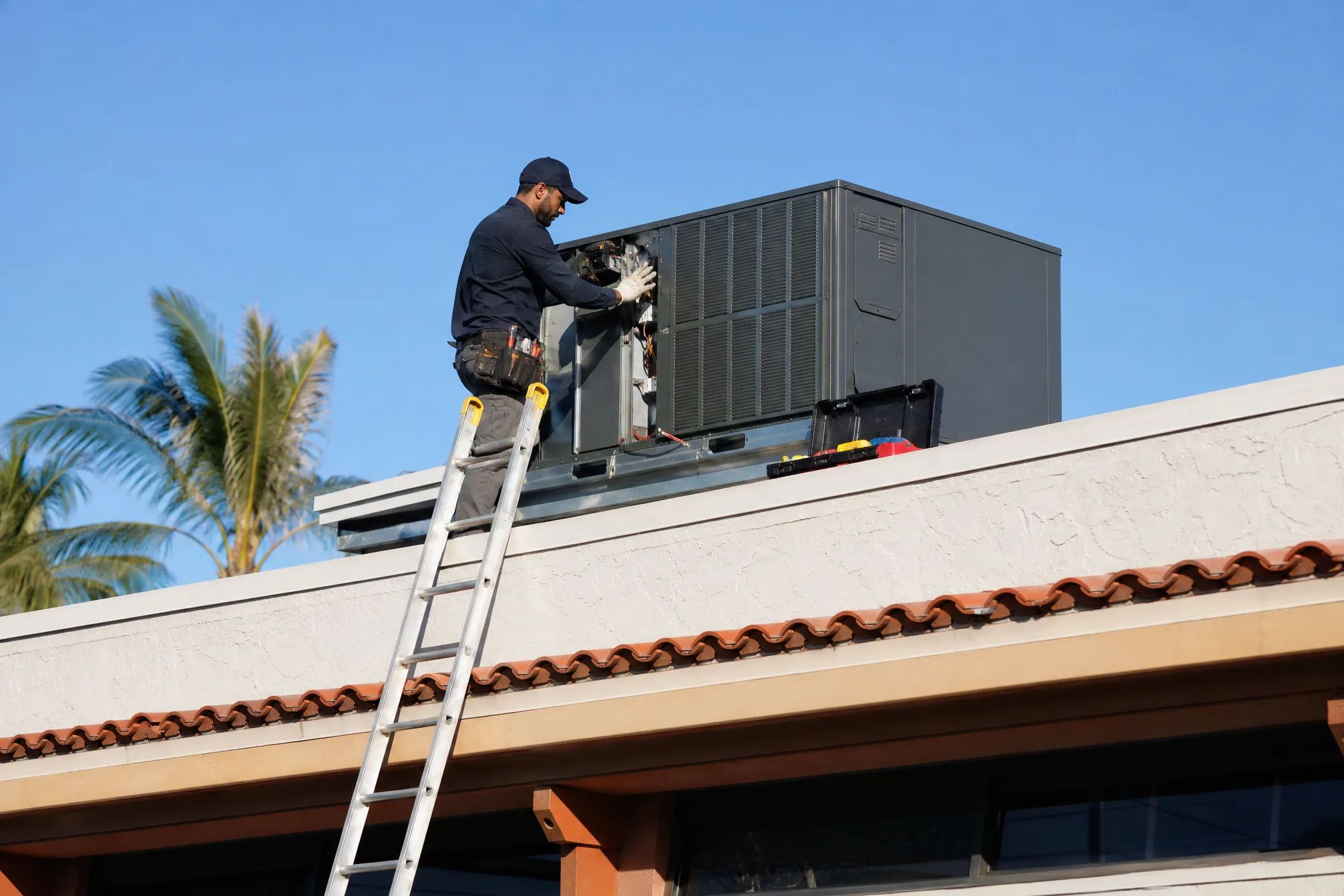
Commercial rooftop units (RTUs) face additional wear from direct sun exposure and require roof access coordination for service — factor this into scheduling flexibility when comparing contractors. Commercial split systems, more common in smaller retail and office spaces, follow a maintenance pattern closer to high-capacity residential systems but with commercial-duty components.
We size every commercial maintenance contract around your specific system count, square footage, and operating hours — not a one-size template. Get a free commercial estimate.
World Air HVAC services commercial AC systems — restaurants, offices, retail, and multi-tenant properties — across Tamarac, Fort Lauderdale, Coral Springs, Pompano Beach, Hollywood, Plantation, Sunrise, Davie, Miramar, and Deerfield Beach.
Protect Your Business From a Summer AC Outage
Custom commercial maintenance contracts sized to your system and operating hours.
