If the smell is strong, chemical, or paired with visible smoke: shut the system off at the breaker immediately and leave the area. Call 911 if you see smoke or flame. For a fainter smell without smoke, work through the causes below.
A burning smell from your AC gets your attention for good reason — but not every burning smell means the same level of urgency. Here is how to tell the difference and what each specific smell is actually telling you.
The One That's Usually Harmless: Faint Dust Smell
If your AC has not run in a while — common in shoulder-season weeks, or after a heat pump switches from cooling to heating mode for the first time — a light layer of dust can accumulate on heating elements, the blower motor, or other components. When the system starts up, that dust burns off, producing a faint, dry, dusty smell for the first 10-15 minutes.
What to do: If it is faint and clears within 15 minutes, this is generally normal and does not require a service call. If it persists longer or gets stronger rather than fading, treat it as one of the causes below instead.
Burning Plastic or Melting Rubber Smell (Urgent)
This points to overheating electrical components — most commonly a failing blower motor, a compressor motor under strain, or a wire with degrading insulation making contact with a hot surface. Plastic components inside the system (wire coatings, some housing components) can begin to soften and smell before they actually ignite, which is exactly why this smell should never be ignored.
What to do: Shut the system off at the thermostat and, if the smell is strong, at the breaker as well. Call a technician promptly. This is not a wait-and-see situation.
Electrical or "Gunpowder" Smell (Urgent)
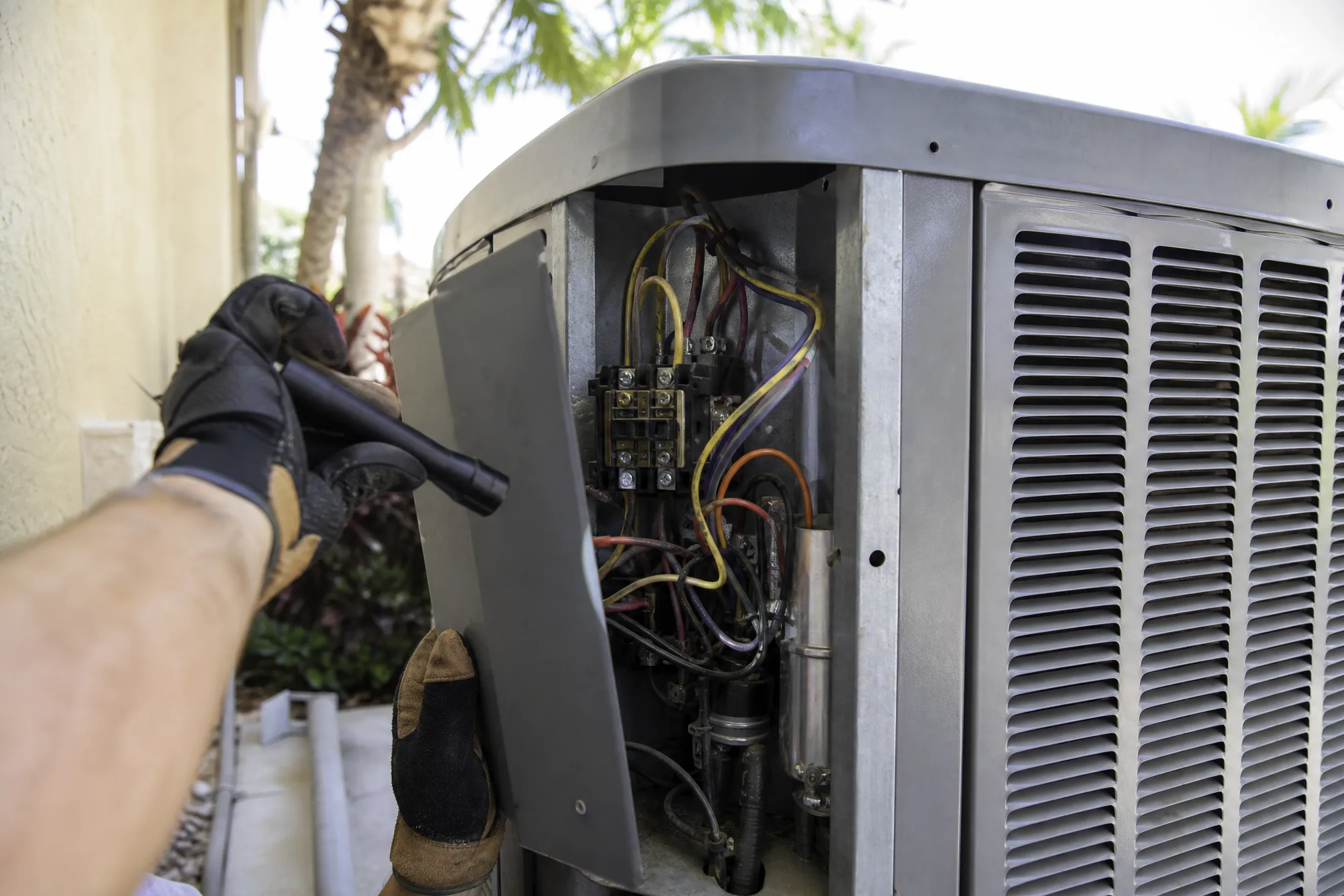
An acrid, electrical, or ozone-like smell — sometimes described as smelling like gunpowder or a struck match — usually indicates electrical arcing somewhere in the system, often at a failing circuit board, a loose high-voltage connection, or a failing capacitor. This is one of the more serious smells on this list because arcing electricity is a direct fire risk.
What to do: Shut off at the breaker immediately, not just the thermostat. Do not attempt to inspect the electrical components yourself. Call for same-day diagnosis.
Musty or Mildew Smell (Different Issue, Not Burning)
Worth distinguishing from true burning smells: a musty, mildew-like odor is a completely different problem — usually mold or bacterial growth in the ductwork, drain pan, or evaporator coil, not an electrical or overheating issue. We cover this separately in our musty smell guide.
What a Technician Checks
- Motor condition — blower and compressor motors are inspected for overheating, worn bearings, or electrical failure
- Electrical connections — high-voltage connections at the contactor, capacitor, and circuit board are checked for arcing, corrosion, or looseness
- Wire insulation — checked for any degradation or contact with hot components
- Airflow restriction — a severely clogged filter can cause a motor to overheat from working against excess resistance, which can itself produce a burning smell
Loose electrical connections and failing capacitors are exactly what Comfort Club tune-ups catch before they become a burning-smell emergency call. See Comfort Club plans.
World Air HVAC dispatches same-day for burning smell calls across Tamarac, Fort Lauderdale, Coral Springs, Pompano Beach, Hollywood, Plantation, Sunrise, Davie, Miramar, and Deerfield Beach — this is treated as a priority call, not a routine appointment.
AC Smells Like Burning? Don't Wait.
Same-day priority dispatch for burning smell and electrical safety calls.
