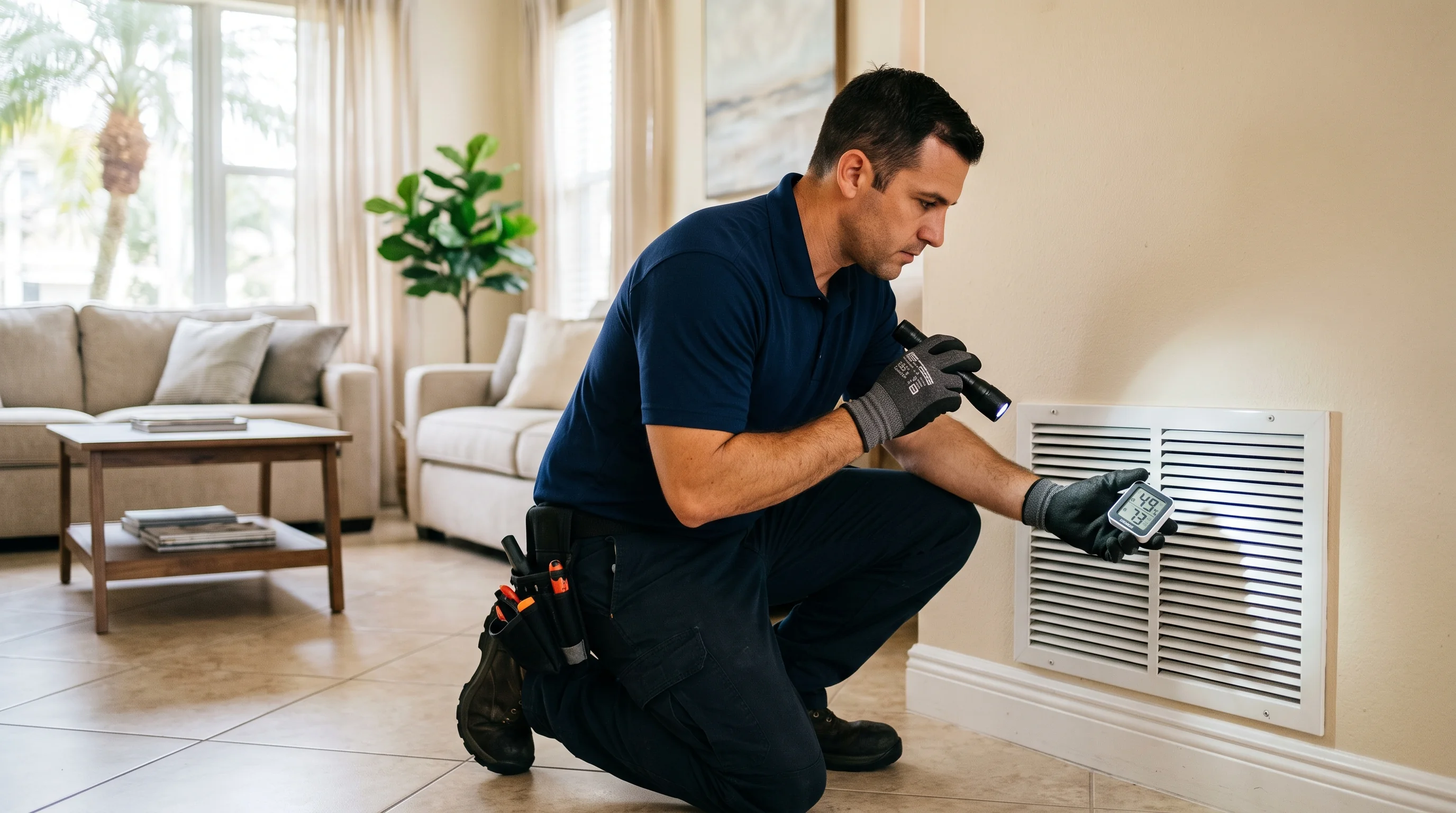
You walk past the hallway vent and catch it — that faint, damp, basement-like smell. Or you pull the cover off a return grille and see dark speckling you are pretty sure was not there last year. The question that follows is always the same: is this just Florida being Florida, or is this actually mold?
It is a fair question, and it deserves a real answer instead of a sales pitch in either direction. Most of the time in Broward County, what you are smelling is ordinary humidity working through a system that needs a filter change, a coil cleaning, or better moisture control — the kind of thing we cover in our guides to musty AC odors and why your home stays humid even with the AC running. But sometimes it is not just humidity, and knowing the difference — and who is actually licensed to confirm it — matters for your health and your wallet.
This guide is not another rundown of musty-smell causes; we already wrote that one. Instead, it is a framework for telling the two problems apart, an explanation of where mold actually takes hold inside an AC system, and an honest account of what a Broward County HVAC contractor can and cannot do about it under Florida law.
Two Different Problems That Feel Identical From the Living Room
Humidity and mold are related but not the same thing. Humidity is a condition — too much moisture in the air. Mold is a biological growth that happens because of sustained moisture, once conditions stay wet or humid long enough. According to the U.S. Environmental Protection Agency, controlling indoor moisture is the central strategy for controlling mold, and materials that get wet need to dry out within 24 to 48 hours or they become capable of supporting mold growth.
That distinction matters because the fixes are completely different. A humidity problem is solved with airflow, filtration, and moisture control — the kind of tune-up and dehumidification work our humidity troubleshooting guide walks through in detail. An actual mold problem, once it is established on a surface, needs to be physically assessed, sampled if warranted, and remediated by someone trained and licensed to do exactly that. Treating a mold problem like a humidity problem — running a dehumidifier and hoping — does not remove what is already growing.
5 Signs It’s Probably Just Humidity
- The smell is strongest right when the AC kicks on and fades within a few minutes, rather than lingering constantly.
- It tracks the weather. Worse during Broward County’s rainy months (roughly May through October), noticeably better in the drier winter stretch.
- No visible staining anywhere — you can see every accessible vent, register, and duct connection and nothing looks discolored.
- A hygrometer reads high, but that is the only symptom. Indoor relative humidity sitting above 60% explains a stuffy, musty feeling on its own, no biological growth required.
- It improves after basic maintenance — a fresh filter, a coil cleaning, or a professional tune-up noticeably reduces or eliminates the smell within a few days.
If most of these describe your situation, start with the fixes in our musty smell guide (dirty coils, clogged condensate lines) and our humidity troubleshooting guide (oversized systems, leaky ducts, missing dehumidification). Both are common, both are fixable by an HVAC contractor, and neither requires a specialized mold license to correct.
5 Signs It Could Be Mold, Not Just Humidity
- The smell is constant, present whether the AC is running or has been off for hours.
- Visible staining — dark, black, greenish, or fuzzy-looking discoloration around a vent, register, duct seam, or air handler closet — especially if it is spreading over time.
- Symptoms that track the house. Headaches, congestion, or respiratory irritation that show up at home and ease noticeably when someone is away for a few days.
- A known water event that was not dried fast. A roof leak, overflowed drain pan, or flooding that was not fully dried within 24 to 48 hours, per EPA guidance on how quickly mold can establish itself.
- The problem keeps coming back after a coil cleaning or filter change that should have resolved a simple humidity issue.
If you see what looks like an established mold colony, resist the urge to scrub it, spray it with bleach, or cut into drywall to "see how bad it is." Disturbing dry mold growth can release spores into the air your family is breathing, making a contained problem worse. Store-bought mold test kits are also not standardized and are widely considered unreliable by indoor air quality professionals — a negative result does not mean there is no problem, and a positive result does not tell you the species, extent, or the right remediation plan. If you suspect real mold rather than ordinary humidity, the right next step is a professional assessment, not a home test kit.
Where Mold Actually Takes Hold in an AC System
Mold needs three things to establish itself: moisture, an organic food source (dust, skin cells, biofilm), and time. Inside a residential AC system, a handful of spots reliably provide all three. The evaporator coil — the cold, wet surface inside your air handler that pulls moisture out of the air as a byproduct of cooling — is the single most common breeding ground in the entire system, because it is damp essentially year-round in Florida’s climate. The condensate drain pan beneath it is a close second when drainage is slow or clogged. Ductwork itself can also support growth at points where condensation collects, typically where insulation has failed or a connection has come loose.
We cover the mechanics of each of those spots — and the specific maintenance fixes for coils and drain lines — in our musty smell troubleshooting guide, so we will not repeat that ground here. What matters for this guide is the "why": constant moisture plus organic debris plus darkness is a standing invitation, which is exactly why prevention at the coil is where World Air focuses its indoor air quality work.
Florida’s Two-License System: Why an HVAC Company Shouldn’t Be the One "Testing" for Mold
Here is something most homeowners do not know, and it is the single most important fact in this guide: Florida is one of a small number of states that regulates mold assessment and mold remediation as their own licensed professions, separate from a general contractor or HVAC contractor license. Under Florida Statute Chapter 468, Part XVI (the Mold-Related Services Act, §§ 468.84–468.8424), anyone performing mold assessment or mold remediation services on an area larger than 10 square feet, for compensation, must hold an active license from the Florida Department of Business and Professional Regulation (DBPR) — a Mold Assessor license to inspect and sample, or a separate Mold Remediator license to perform cleanup. These are two distinct credentials, and by rule, the same company generally cannot both assess and remediate the same job, which keeps the person confirming a mold problem from also profiting off "finding" one.
A proper licensed mold assessment typically includes a visual inspection of the affected area, moisture readings taken with a meter, and — when warranted — air or surface sampling sent to an accredited laboratory for analysis. If remediation is needed, the assessor's findings inform a written protocol that a licensed remediator follows, and in more significant cases, a post-remediation clearance assessment confirms the work was successful before the area is closed back up.
Whether you are hiring an HVAC contractor, a mold assessor, or a mold remediator, you can verify their Florida license is active at myfloridalicense.com before any work begins. World Air HVAC's license, CMC1250582, is a mechanical contractor license — it authorizes us to install and service AC, duct, and indoor air quality equipment. It does not authorize mold testing or remediation, and we will never tell you otherwise.
What World Air Actually Does: Prevention, Not Mold Testing
Our honest role in this picture is the prevention and moisture-control side of the equation — the work that keeps a humidity problem from ever becoming a mold problem in the first place, and that reduces the odds of regrowth at the spot most prone to it.
- UV coil purifiers installed directly at the evaporator coil, running continuously and proven to kill up to 99.9% of the mold, bacteria, and viruses that land on that surface — the number one breeding ground in any Florida AC system.
- Whole-house dehumidifiers, installed for $1,500–$3,500 depending on your home and equipment, sized to maintain 45–55% relative humidity throughout the house automatically — comfortably inside the EPA’s recommended range for limiting mold risk.
- Duct inspection and cleaning to remove the organic debris and biofilm that give mold something to feed on in the first place.
- Free IAQ assessments where we measure humidity and inspect your coil, drain pan, and accessible ductwork — and tell you plainly if what we see looks like it needs a licensed mold assessor rather than an HVAC fix.
If a visual inspection turns up something that genuinely looks like established mold growth — not just a musty smell or high humidity reading — the responsible move is a referral to a Florida-licensed mold assessor, not a UV light and a dehumidifier and a hope it goes away. We would rather lose that piece of the job than tell you something is fixed when it is not.
Frequently Asked Questions
How can I tell if my vents just have humidity buildup or an actual mold problem?
Humidity issues tend to be seasonal, smell strongest right when the AC kicks on, and fade after a filter change or tune-up. A likely mold problem is more persistent: the smell is there whether the AC is running or not, there is visible dark or greenish staining around a vent or duct seam that keeps spreading, or someone in the house feels noticeably better when they are away from home. When you see staining plus a smell that will not resolve, it is time for an inspection instead of another filter change.
Does World Air HVAC test for mold?
No, and we will tell you that directly. Florida licenses mold assessment and mold remediation as their own professions under Florida Statute Chapter 468, Part XVI, separate from an HVAC contractor’s license. Our role is coil and duct inspection, UV coil purification, and whole-home dehumidification — the prevention side. If we see something during a service call that looks like it could be mold, we will tell you honestly and point you to a licensed mold assessor for testing, rather than guess.
Who is actually licensed to test for and remove mold in Florida?
A Florida-licensed Mold Assessor performs the inspection and any sampling, and a separately licensed Mold Remediator performs the cleanup, per Florida Statute Chapter 468, Part XVI. By rule, the same company generally cannot do both jobs on the same property within a set period, which keeps the assessment honest — the person testing for mold has no financial stake in finding it. You can verify any mold assessor or remediator’s license at myfloridalicense.com before hiring them.
Does a UV coil purifier get rid of mold that’s already growing?
A UV coil purifier is a prevention tool, not a remediation tool. Installed at the evaporator coil, it runs continuously and is proven to kill up to 99.9% of mold, bacteria, and viruses that land on the coil surface, which stops new colonies from establishing in the spot most prone to growth. It is not a substitute for professional remediation of an existing, established mold problem elsewhere in the ductwork or home.
What indoor humidity level actually prevents mold growth in a Florida home?
The EPA recommends keeping indoor relative humidity below 60%, and ideally between 30% and 50%. World Air’s whole-house dehumidifiers are sized to maintain 45-55% relative humidity throughout the home automatically, which sits comfortably inside that target range and removes the moisture mold needs to establish itself in the first place.
