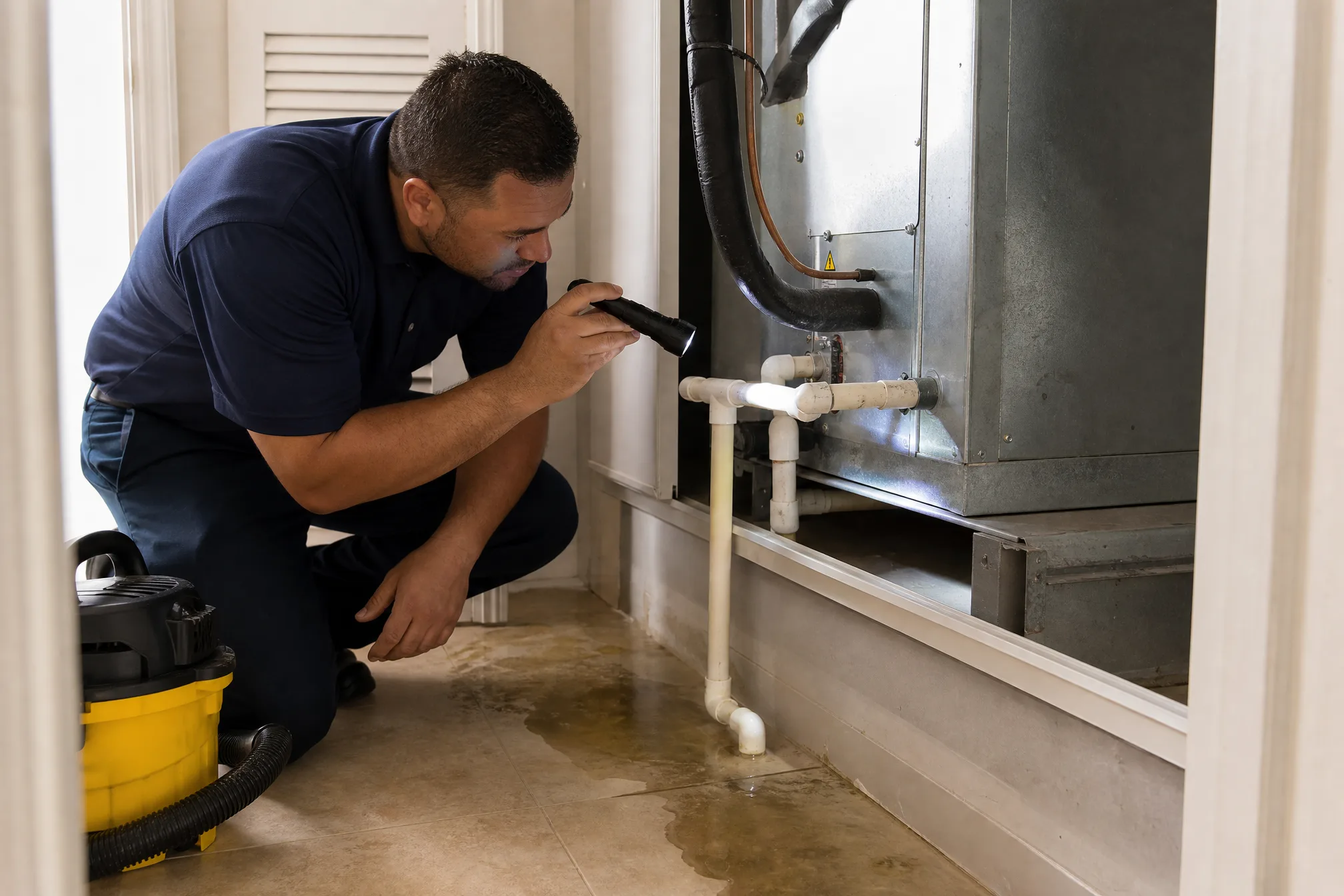
First step, before anything else: switch your thermostat to OFF. Water inside the house next to electrical components and drywall gets worse every hour the system keeps running. Then work through the causes below.
Broward County humidity means your AC pulls gallons of water out of the air every single day — that water has to go somewhere, and it is designed to drain outside quietly through a PVC pipe you never think about. When that system fails, the water finds the next easiest path: your ceiling, your closet floor, or the drywall around your air handler.
We run this call constantly in South Florida, especially May through October. Here are the five real causes, in the order we check them, plus what you can safely try yourself before calling a tech.
1. Clogged Condensate Drain Line (The #1 Cause, By Far)
Your air handler has a drain pan underneath the evaporator coil that catches condensation and channels it through a PVC pipe, usually to a drain near your exterior wall or into a floor drain. In Florida's humidity and year-round AC use, algae and mold build up inside that pipe faster than almost anywhere else in the country. Eventually it clogs completely, water backs up into the pan, and overflows into your home.
Telltale signs: water only appears when the AC has been running for a while, you can hear a gurgling sound near the air handler, or you find the exterior PVC drain pipe outside is bone dry when it should be dripping.
What you can try: Locate the drain line's exterior termination point (usually a white PVC pipe near your condenser or foundation). If you have a wet-dry shop vacuum, seal it against the pipe opening and run it for 60 to 90 seconds to pull the clog out. Many Florida homeowners keep a vacuum attachment specifically for this. If water clears and starts flowing, you likely just fixed it — but book a Comfort Club tune-up to flush the line properly before it clogs again.
2. Frozen Evaporator Coil That Is Now Melting
If your filter is dirty, refrigerant is low, or airflow is otherwise restricted, the evaporator coil can freeze into a block of ice. That ice does not cause a leak while it is frozen — the leak shows up later, when the system cycles off (or you shut it off) and the ice melts faster than the drain pan can handle. This is often confused with a drain clog because the water shows up at the same spot.
The giveaway: check the indoor coil or the insulated copper line going to the outdoor unit. If you see or recently saw ice, this is your cause, not the drain line. Full breakdown of causes and fixes in our frozen AC guide.
3. Cracked, Rusted, or Overflowing Drain Pan
Metal drain pans on older systems (10+ years) rust through in Florida's humidity. Plastic pans crack from age or from being bumped during other service work. Either way, water leaks straight through the pan itself rather than overflowing the top of it — so you will see moisture directly under the air handler even when the drain line is completely clear.
Fix: The pan has to be replaced. This is a straightforward repair, $250 to $600 depending on whether it is a standard secondary pan or requires partial disassembly of the air handler to access.
4. Disconnected or Poorly Sloped Drain Line
If your AC was installed or serviced recently and the leak started right after, check whether the PVC line was properly glued and pitched. A drain line needs a consistent downward slope to work by gravity. Loose fittings or a line that was jostled during an install can create a low spot where water pools and eventually backs up.
This is a workmanship issue that any licensed installer should fix under warranty at no charge. If you paid for a recent install or repair and this is happening, call the company back before paying anyone else.
5. Missing or Malfunctioning Condensate Pump
Air handlers installed in an attic or a location where gravity drainage is not possible use a small condensate pump to actively push water out. These pumps have a float switch and a small motor that fail over time — typically 5 to 7 years of service life in Florida's heat. When the pump fails, water has nowhere to go but up and over the reservoir.
Fix: Condensate pump replacement runs $150 to $350 installed. If your air handler is in the attic, ask your technician whether a secondary drain pan with its own safety switch is installed — code requires it in most Florida jurisdictions specifically to prevent ceiling damage from this exact failure.
Every Comfort Club visit includes flushing the condensate line and checking the pan and pump before they fail — the single most preventable cause of Florida AC water damage. See Comfort Club plans.
When to Call a Tech Immediately
- Water is visibly dripping from a ceiling light fixture or ceiling stain is spreading
- You tried clearing the exterior drain line and water is still backing up
- The float switch has shut your AC off completely (a built-in safety feature — do not bypass it)
- You see water near any electrical panel, outlet, or the air handler's control board
World Air HVAC technicians carry wet-dry vacuums, replacement pans, and condensate pumps on every truck, so most water-leak calls are resolved same visit. We dispatch across Tamarac, Fort Lauderdale, Coral Springs, Pompano Beach, Hollywood, Plantation, Sunrise, Davie, Miramar, and Deerfield Beach.
AC Leaking Water in Your Florida Home?
Same-day diagnosis and repair. We carry the parts on the truck.
